Uber has agreed to pay 28.5 million dollars to settle claims that a $1 “safe rides fee” charged to riders was misleading.

The cases of Philliben v. Uber Technologies, Inc. and Mena v. Uber Technologies, Inc., which have since been consolidated into one case on behalf of Uber passengers seeking restitution. The passengers have sued the company because the background checks on drivers aren’t as rigorous as the company advertised. This is a part of an ongoing narrative that Uber leads its customers to believe that their service is more safe than it actually is.

“The civil enforcement action is still ongoing,” said Alex Bastian a spokesperson for one of the prosecutors in the case. “There are laws to protect consumers, and any time a company deviates from those laws, they need to be punished and they need to be deterred.”

There are roughly 25 million passengers involved in the settlement, which yields nearly $1.14 to each before attorney fees.  Bastian said that his office will “take a hard look” at whether $28.5 million in restitution is sufficient. In addition to the settlement, Uber is now stating that it will change the terms used to describe safety related features and will be using terms like “booking fees” in the future.

Uber first added the $1 safe ride fee in April 2014 to help pay for its safety program, which includes driver training, background checks and vehicle inspections. But passengers were unsatisfied, citing several incidents with Uber drivers which called into question the industry leading background checks that the company claimed to offer. In Uber’s release, the company recognizes that “accidents and incidents do happen,” which is “why it’s important to ensure that the language we use to describe safety at Uber is clear and precise.”

This is just the latest in a series of legal battles facing the popular company. Last month, Uber was fined $7.6 million by the California Public Utilities Commission for failing to provide information “in a full and timely fashion” around the number and percentage of customers who requested cars, and how often it could provide rides for them. Meanwhile, Uber is still battling the class action lawsuit around reimbursing drivers for gas and other expenses. That lawsuit is set to go to trial this summer in June.


Article via: TechCrunch,11 February 2016, Bloomberg, 11 February 2016

Photo Uber launch Party by 5chw4r7z

Hackers were recently able to break into the IRS and steal taxpayer identification numbers. The agency was able to detect the attack and shut it down on Tuesday. The breach means that it may be possible for the hackers to file fraudulent tax returns. The attack was done by attempting to obtain e-filing pins from over 450,000 stolen social security numbers. Attempts involving about 100,000 of those social security numbers were successful, the IRS said in a statement.

The IRS stated that the attacks did not originate in their system. It appears as though the social security numbers were stolen outside the IRS, and then used in the attack. They added that “no personal taxpayer data was compromised or disclosed” by its systems. The IRS said it will notify people affected by the attack and will mark their accounts to guard against identity theft.

All of this is part of why President Barack Obama proposed, on Tuesday, to spend $19 billion on more secure technology for the government. If approved, the funds would help in efforts like recruiting cybersecurity experts, reducing reliance on unsafe items like social security numbers. “The caliber of the enemy we’re facing is incredibly sophisticated and global,” IRS Commissioner John Koskinen told the Senate Finance Committee at a hearing Wednesday, in response to a question about the most recent hack. The attackers are professionals that steal sensitive data from their targets, government and financial institutions throughout the world.

Attacks like these have become more prevalent as more tax filing and banking is done online. In the US 150 million tax returns are expected to be filed this season, with 80 percent of them expected to be filed online.

Despite storing a massive trove of data on American citizens, the federal government has struggled to protect it from hackers. That includes the IRS, which hackers attacked last year to steal tax records of perhaps 300,000 people. The agency has even struggled with fraudsters in its ranks; on Monday it successfully prosecuted an employee for identity theft and conspiracy to commit bank fraud.

Article via CNET, 10 February 2016

Photo: Please Insert Coin by arsheffield[Creative Commons Attribution-NonCommercial-NoDerivs]

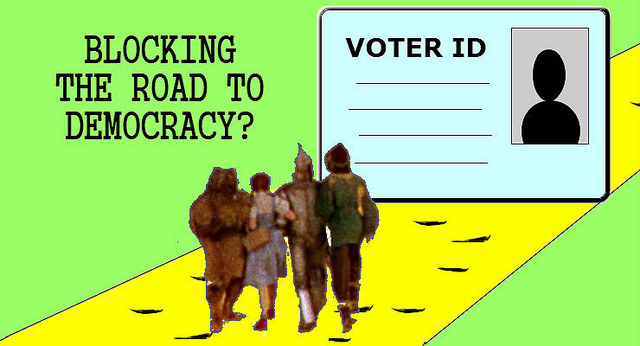
Voter ID requirements are having an effect on suppressing voters, especially those of color, a recent research paper claims.

UCSD’s political science department has conducted research on the recent voter ID law changes, and have found that they are changing the makeup of voters. In the past few years there has been a wave to restrict voting to those that cannot show a proper ID. The motivation has come from the sentiment that if you need an ID to board a plan, then you should need one to vote. There is growing concern that allowing citizens to vote without showing proper ID could open up the process to fraud, via people using the names of the recently deceased to cast illegitimate votes. Other reasoning behind the updates to the law have stated that requiring an ID is a minor barrier to voting and should not have an effect on the process. This has been backed up by past research that showed that there was no difference between the voters who had to show an ID and those that were not required to in order to vote.

The problem is that these laws seem to be fixing a problem that doesn’t exist. It has been reported that most instances of voter fraud tend to be baseless. In contrast, the creation of an ID requirement has been found to be a barrier for voters.  It is estimated that 10% of Americans do not have the proper ID in order to cast a vote. As a result, the voting population gets skewed to being more white and more conservative. Some Republicans have admitted that defense of the new voter ID laws are aimed at the democratic voters.

The researchers found that these claims were turning out to be true. “We find that strict voter identification laws do, in fact, substantially alter the makeup of who votes and ultimately do skew democracy in favor of whites and those on the political right.” They even draw a broader point from this finding: “These laws significantly impact the representativeness of the vote and the fairness of democracy.”

Voting is not a privilege, it is a fundamental right of our democracy. Before 2006, not one state required that a person have a photo ID in order to cast a vote. Although past research may not have indicated that Voter ID laws would become a barrier to a civil right, this research generally pre-dates the especially strict voter ID laws that are on the books in many states today. Although the most recent study is still under peer review, it results are enough to cause alarm about the state of our voting rights in America.

Article via AboveTheLaw.com, 9 February 2016

Photo Proof Voter ID Lowers Turnout by Democracy Chronicles [Creative Commons Attribution-NonCommercial-NoDerivs]

Yahoo is being sued by a former employee that claims that he was discriminated against for being male.

Gregory Anderson, who was employed in Yahoo’s media division was fired in November 2014.  He filed a lawsuit against the tech giant, alleging the company’s performance management system was arbitrary and unfair. Anderson “alleges that Mayer encouraged and fostered the use of the QPR Program to accommodate management’s subjective biases and personal opinions, to the detriment of Yahoo’s male employees.”

The QPR Program at Yahoo is the controversial quarterly performance review program that ranks employees and then fires the lowest ranking ones. In the Media division, where Anderson was an editor, the complaint says that when male and female employees got equally low scores (anything under 3), the women were favored and the men were fired. What’s worse, in the case that both male and female employees got the same score, the men were fired and the female employee took over the male employees job.

This isn’t the first discrimination lawsuit to be tied to a stack ranking system. In the early 2000s, a cascade of cases against Ford, Goodyear, and Capital One, alleged that such systems led to age discrimination against older employees

The lawsuit also alleges that in addition to discriminating against men, Yahoo fires people without just cause and did not give 60 days’ notice to staff affected in mass layoffs. In California, layoffs are defined as terminating more than 50 people at one time, therefore not providing notice violates California law. In addition to the complaint about the way that people were fired, Anderson’s complaint also alleges that there was unfair gender based biased for hiring.  Former Chief Marketing Officer Kathy Savitt, almost exclusively hired women into management positions in Yahoo’s media division.

Under Title VII of the 1964 Civil Rights Act and also California’s Fair Employment and Housing Act, discrimination on the basis of sex is illegal. It doesn’t matter which gender the person happens to be.

“The Anderson lawsuit raises the question of how to correct lingering gender discrimination against women and suggests that the answer is not yet more illegal discrimination,” wrote Anderson’s attorney Jon Parsons in a statement about the lawsuit.

Article via Huffington Post, 4 February 2016

Photo: Yahoo! by Eric Hayes [Creative Commons Attribution-NonCommercial-NoDerivs]

Over 100 days after the beginning of a natural gas leak near the the Porter Ranch neighborhood, criminal charges are being brought against Southern California Gas Company. Los Angeles County District Attorney Jackie Lacey has filed charges due to failing to immediately report the natural gas leak at its Aliso Canyon facility to proper authorities, her office announced Tuesday. Southern California Gas Company is being charged with four misdemeanor counts: three counts of failing to report the release of hazardous material from Oct. 23 to Oct. 26 and one count for the discharge of air contaminants starting Oct. 23 through the present, according to the complaint.

In late November, 58,000 kilograms of methane per hour have been leaking into the atmosphere due to the breach. Since then, the natural gas leak has released emissions equivalent to burning more than 862,000 gallons of gasoline.

Methane is the primary component of natural gas, and can leak almost anywhere in the supply chain. Methane leaks like this, are a contributing factor to climate change and the overall warming of the environment. Figures from 2007 showed that there are about 400 underground methane storage sites like Aliso Canyon (Southern California Gas Co. current major leak), and these storage facilities are poorly regulated. There’s little federal oversight of such facilities, and the state is not consistent with enforcing regulations. This lack of oversight creates opportunities for such large leaks to go unnoticed and in this case, unaddressed for so long. Souther California Gas Company say that the leak will finally be stopped by late this month, but the methane will linger in the atmosphere, most likely for decades.

The gas company could be fined up to $25,000 a day for each day that it failed to notify the California Office of Emergency Services and up to $1,000 per day for air pollution violations.

“It is important that Southern California Gas Co. be held responsible for its criminal actions… We will do everything we can as prosecutors to help ensure that the Aliso Canyon facility is brought into compliance,” stated District Attorney Jackie Lacey in a written statement.  “I believe we can best serve our community using the sanctions available through a criminal conviction to prevent similar public health threats in the future.”

Arraignment for the company is set for Feb. 17 at the Santa Clarita Branch of the Los Angeles County Superior Court.

Article via fivethirtyeight.com, 3 February, 2016; Daily News, 2 February 2016

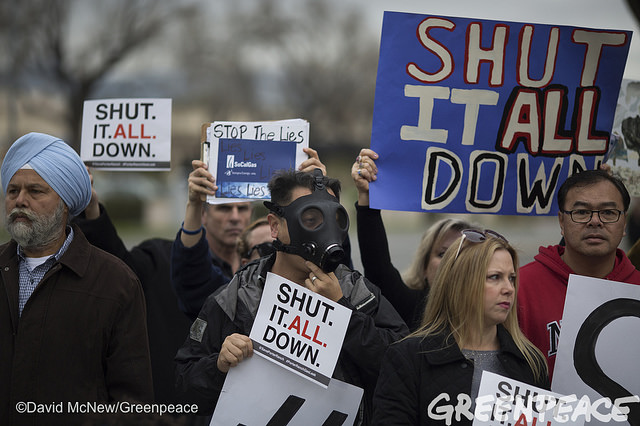
Photo Demonstrating On The Leak by Greenpeace USA [Creative Commons Attribution-NonCommercial-NoDerivs]

On Monday, Alphabet, the company that owns Google, overtook Apple by becoming the most valuable company in the world.

The most valuable companies in America are nearly all tech companies. Google and Apple are leading the pack with market values of $543 billion and $535 billion respectively. Behind those two companies sits Microsoft at $433 billion. Facebook, at $328 billion, took fourth on Monday, surpassing Exxon Mobile at $318 billion. The revenues of the top leaders (Google and Apple) are higher than any other company in corporate history.

Just last quarter Alphabet reported revenues of more than $21.3 billion, blowing past estimates by roughly half a billion dollars. Traders are expecting Alphabet to keep the title of most valuable company for some time to come. Revenue for the company saw $74.5 billion in sales for all of 2015, up from $66 billion in 2014. The good news keeps coming as Monday their stock rose another 5 percent.

Colin Gillis, senior technology analyst for BGC Partners, believes that Alphabet will become the world’s first trillion dollar company. Why? Sheer numbers, for one, Gillis said in an interview. “Think about the number of services they have with a billion users: Google Search, YouTube, Maps. Some of those are used multiple times every single day,” he said.

Some also think that the deciding factor between Google and Apple is all about China. Apple reported the slowest-ever sales growth for the iPhone and revealed that its business in China is facing trouble. In contrast, Alphabet makes very little money off hardware and does almost no business in China. Now that China’s economy is slowing down, Apple and their stock seem to be following suit.

It could be that Alphabet knows exactly how to show investors its future promise. Google has been famous for its moonshots, like the self driving car. The reorganization of Google, including the creation of the parent company Alphabet, has allowed transparency into its many services and what they offer. All that adds up to a lot of success and the number one spot for the tech company.

Article via The Washington Post,1 Febraurary, 2016

Photo: iPhone Alphabet by schnaars [Creative Commons Attribution-NonCommercial-NoDerivs]