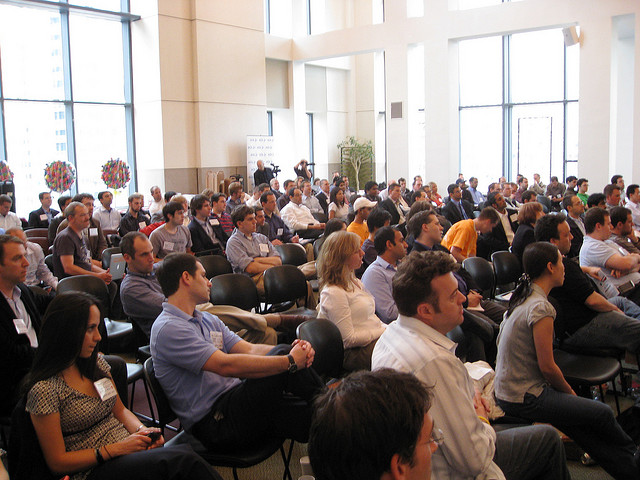
Legaltech is the most important legal tech trade show of the year.  It is the number 1 resource for law firms and professionals to get the latest information for law practice management. The next show is scheduled for February 2-4 2016 in New York City. If you plan on attending, this post is meant to give you a few tips to get the most out of the conference. These are tips coming from Legal tech marketers on having a great experience at Legaltech this year.

1. Get started early

Get in touch with your contacts before you get to the conference. Make appointments now so that you will have an agenda of people to meet with when you arrive.

2. Start updating your social media feeds

Social media can be a powerful way to make connections with those that you know and those that you don’t yet know. When it comes to big events like this, it is inevitable that those within your industry will be abuzz with information leading up to the show. Use this as an opportunity to bring attention to your legal business and yourself.

3. Attend editors’ and bloggers’ breakfast

These are free events so there is nothing to lose. It will also give you the chance to be exposed to thought leaders in the industry as well as learn about what is coming next. You will get access to dynamic editorial and leadership teams, as well as entrepreneurs working in your industry.

4. Write about your experience

You can write anything from a blog post on your company site to a series of tweets. What is important is sharing your experience. This will not only give you the chance to attract an audience of curious colleagues, but this will also give you another chance to bring attention to your own practice or firm.

Article via LegalTechNews, 14 January 2016

Photo: Tech cocktail conference crowd by Frank Gruber [Creative Commons Attribution-NonCommercial-NoDerivs]

Sexual harassment in Silicon Valley has affected 60 percent of the senior women in technology, according a recent survey. The survey, Elephant in the Valley, surveyed more than 200 women of power and influence in the Bay Area. According to the respondents, nearly 60 percent of these women stated that they had received unwanted sexual advances in the workplace. 65 percent of those advances came from a superior, and 1 in 3 stated that the advances made them fear for their safety.

The authors of the survey wrote that they were inspired by the conversations generated by the Ellen Pao trial. Writing on their website the authors stated, “What we realized is that while many women shared similar workplace stories, most men were simply shocked and unaware of the issues facing women in the workplace. In an effort to correct the massive information disparity, we decided to get the data and the stories.”

Treo Vassallo, an investor and advisor who participated in the Ellen Pao trial was also one of the authors of the survey. She testified against Kleiner Perkins during the trial , vividly recalling her own experience being sexually harassed by a former partner at the VC firm. Afterwards, she stated that a large number of women approached her with their own horrifying stories of harassment. Moved by what she heard from others, Vassallo wanted to be a catalyst to continue to conversation and bring change.

Part of the problem could be that women are the minority in the tech world. Nearly 80 percent of reported sexual harassment crimes are committed by men against women, especially when men are senior to them. The purpose of this survey is to make these numbers more visible. The hope is that by bringing these stories to light, and exposing the data that has been collected, the male-dominated culture of sexual harassment will be tempered within the workplace.


Article via Cnet, 11 January 2016

Photo: Trae Vassallo, Kleiner Perkins Caufield & Byers by Dow Jones Events [Creative Commons Attribution-NonCommercial-NoDerivs]
Handshake Software, a provider of SharePoint-based products and services to the legal market, announced its tech integration Ravel Law, a legal search, analytics, and visualization platform. The move is based on the need to provide a legal search product to law firms that will allow them to be more efficient in their practice.

Glenn LaForce, vice president of global sales & marketing at Handshake Software stated, ““Attorneys are under tremendous pressure from their clients with regards to the billable hour, so bringing together as many data sources as possible into one universal search is paramount for their practice,” he said. “To be able to perform legal research while seeing key financials, internal documents, contacts and internal expertise helps the attorneys become more efficient and effective.

This move is a strategic integration between the two companies products. By combining these technologies, the users Sharepoint experience will include search that allows for all knowledge to be in one place. LaForce confirms this by saying, “Lawyers, CIOs and knowledge management professionals tell us they want one system to deliver one-stop [knowledge management] information to their users. Our integration with Ravel Law is another important aspect of the Handshake Software’s all-encompassing solution that includes integration to online legal research and other major legal applications.”

The goal is to provide and environment where users will have access to critical firm data as well as online law research materials. This allows attorneys to more effectively manage the business and practice of law. We’re excited to bring these technologies to lawyers in one easy-to-find location,” said Nik Reed, co-founder and chief operating officer at Ravel Law.


Article via LegalTechNews, 12 January 2016

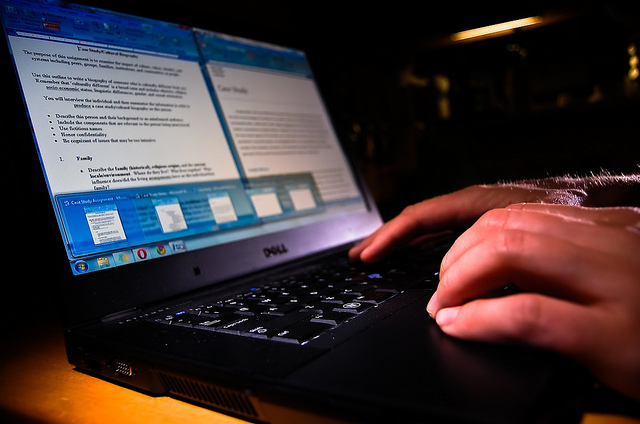
Photo:Assignments by Ryan Hyde [Creative Commons Attribution-NonCommercial-NoDerivs]

President Obama is ordering the federal government to study smart gun technology.

On Monday, Obama told the departments of Defense, Justice and Homeland Security to look into smart gun technology, such as fingerprint and radio-frequency identification. The goals are to track lost or stolen guns and to prevent accidental gunfire. The president cited a 2013 Department of Justice report as inspiration for the studying smart gun technology. Obama was quoted saying that “…the (DOJ) made clear that technological advancement in this area could help reduce accidental deaths and the use of stolen guns in criminal activities…”

These actions and others were addressed in a speech from the White House on Tuesday by the President. Obama outlined this memo and other executive actions meant to tackle gun violence. This speech comes one month after 14 people in San Bernardino, California were fatally shot by a couple influenced by radical islamic beliefs. In response, gun sales rose sharply amid fear of extremists.

In addition to encouraging gun safety, these executive actions will expand background checks in order to  close the “gun show loophole”. This loophole allows gun dealers conducting business at gun shows or online to do so without conducting background checks. Current laws exempts gun collectors and hobbyists from conducting background checks before selling a firearm.

Although The President’s recommendations are consistent with the Second Amendment and supported by the “overwhelming majority of the American people, including gun owners”, it is unlikely to find support among gun rights groups. These groups have stated that smart technology is a way for the federal government to track gun owners.

Chris Cox, executive director of the National Rifle Association’s Institute for Legislative Action, said in a statement Tuesday that the NRA would not allow “law-abiding gun owners to become scapegoats for President Obama’s failed policies…The NRA will continue to fight to protect the fundamental, individual right to keep and bear arms as guaranteed under our Constitution.”

Obama plans to address gun violence during a nationally televised town hall meeting at George Mason University in Virginia on Thursday night. In his speech Tuesday, he recalled the 2012 shooting at Sandy Hook Elementary School in Connecticut that left 20 children and six teachers dead. Obama stated, “Every time I think about those kids, it gets me mad”.

In his memo, he continues with that sentiment stating that “…developing and promoting technology that would help prevent these tragedies is an urgent priority…”

Article via CNET, 6 January 2016

Photo: 44 by SAL [Creative Commons Attribution-NonCommercial-NoDerivs]

Google has been famously testing out their version of a driverless car. The company wants to transform transportation by taking the driver out of the equation.

Driverless cars will be able to shuttle people from place to place while reducing the human error that is often the catalyst for road accidents.The California Department of Motor Vehicles recently made a proposal of rules for driverless cars. These new rules were presented for public commentary in mid December of 2015. The DMV wants to involve the public and will be hosting two workshops early in 2016, one in Sacramento and the other in Los Angeles.This proposal draft is the next step in allowing driverless cars on California roads. But Google is unhappy about one of the provisions.

The regulators are calling for the manufacturers of driverless cars to meet several safety and performance standards. These include things such as protecting the privacy of operators from the needless collection of user data and having a third party independently access performance. The rules also call for a licensed human driver, capable of taking over the steering wheel and pedals in the event of an emergency. The problem is that Google’s prototype for a driverless car does not have a steering wheel or pedals.

Google’s maintains that it wants to improve safety by equipping the car itself with protocols that surpass what a human could detect. For instance their cars have sensors that detect objects as far as two football fields away–in all directions. The state of California is looking at the broader aspect of autonomous cars, and remains more conservative on the issue. They  have warned Google in the past to add steering wheels and pedals. California legislators pushed The DMV to require that driverless cars contain wheels and people to steer them whenever they’re operated on public roads.

Google is disappointed that California legislators are limiting the potential of fully autonomous vehicles, the company said. Although the company is still in the prototyping phase where changes can easily be made, it is still a setback.


Article via TechNewsWorld, 18th December 2015

Photo:Auto che guidano da sole. Forse non le vedremo mai sulle nostre strade by Automobile Italia [Creative Commons Attribution-NonCommercial-NoDerivs]

Internet security is an important topic to address for anyone who surfs the web. Many of us want to be sure that our private data is being handled securely. The most popular way to protect our data online is through encryption. Encryption of data simply means that the information is encoded so that it can only be read by a key used to decode it. It sounds like super spy stuff, and in a way it is (that is a German enigma machine pictured above). In this article, we will discuss some of the ways that encryption is used to protect our data on the internet.

Computer encryption is based on cryptography, the practice and study of techniques to secure information. If you have ever heard of the Caesar cipher, that is a form of encryption. In our modern era, computers are generating complex algorithms that are used as the ciphers that crack the code.

There are two main modes of encryption: symmetric key and public key.

Symmetric key encryption

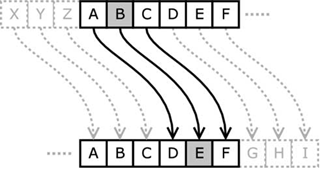
Caesar_Cipher
Caesar Cipher by prize Lerthirunvibul

The Caesar cipher is a great example of this. A letter is written to a friend, but all the words are spelled out by rotating the letter in the alphabet 4 spaces. This makes the letter nonsensical to anyone who intercepts it. But the friend it was written to knows the code (shift 4 spaces) and can therefore decode the letter.

The same happens in computing. Each computer has a secret code. The is a packet of information that is transported between the two computers. Once the transfer is complete the second computer decodes the encrypted packet.

Examples of this type of encryption: Hard drives, Private networks


Public key encryption

public key encryption
PublicKeyEncryption by Kalani Hausman

Sometimes this is called asymmetric key encryption. The main difference here is that each party does not have the same code to encrypt the message. Instead this method uses two different keys at once, a public key and a private key. The private key is know only to your computer. While, the public key is given to any computer that may want to communicate with it.

To decode a message a computer must use the public key (provided by the computer that it is communicating with) and it’s own private key.

In the example, Sally wants to send Bill a message. To do that, Sally needs to use Bill’s public key which is available to anyone. When Sally uses the public key it encrypts the message so that no one can read it. The only way that Bill will be able to see the message is when he uses his private key, the one that only he has (and is the only way to decode the encryption).

The message is available to anyone because all you need is the public key to pick it up. But, you won’t be able to read that message without a private key. The keys are a long string of numbers, and since they are based only on prime numbers, it makes this system very secure.

Examples of this type of encryption: Digital banking, Secure websites(https, SSL)

Photo Caesar Cipher by prize Lerthirunvibul

Photo PublicKeyEncryption by Kalani Hausman

Photo: WW2 Encryption: Enigma German Machine – cover off by Anthony Catalano [Creative Commons Attribution-NonCommercial-NoDerivs]