Recently President Obama got a Facebook page. The reason he stated was to make it easier for the public to have access to the president. He also wanted to have more conversations with real people. Using social media to make connections and grow relationships is a  great way to harness the power of a social media presence. For a lawyer, social media can be a way to be more visible and to reach more clients.

The goal of social media is to get noticed. In the social media world, it means being at the forefront of people’s mind. You can achieve that by making posts that stand out in people’s feeds. The trick is to say things that are interesting to  your followers so that they repost your content. In this post, we will look at ways that social media can help your business.

  1. Social media is an easy way to learn your audience. No matter the industry, it is always beneficial to have insight into who is interested in your product or service. Using social media will allow you to build an audience. As this audience builds you can use tools like google analytics. This allows you to see information about your audience like their age, location, and what posts are being read the most.
  2. Social media can help increase traffic to your website. Many law firms have a site showcasing their business. Having active social media accounts with good content can help drive people to your website. In addition to helping drive new customers to your site, it will also increase your rank in search engines making it easier for other new clients to find you.
  3. Social media helps generate leads for one third the cost. Outside of creating content in the form of posts and picture, you can use social media to advertise your business. Facebook ads and twitter ads allow a firm to easily reach a large audience for a very low price. Advertising starts on some platforms at just 5 dollars. Analytics associated with advertising can be reviewed with known data about your audience so that ads can be targeted to specific audiences.

Social media is fast and delivers news and updates at a record pace. It is also a great way to build your brand and make your clients aware that your firm exists. Don’t over look using social media as a means of improving your relationships with current and future clients.

Photo: social media class via mkhmarketing [Creative Commons Attribution-NonCommercial-NoDerivs]

In the wake of the recent terrorist attacks in Paris, French law enforcement is considering banning public wi-fi. According to leaked documents by the French Ministry of the Interior, law enforcement wants to secure the Tor network when a state of emergency is declared by banning the use of the public wi-fi all together. The French newspaper La Monde  is said to have leaked the documents.

The city of Paris currently has over 300 locations that are serviced by public wi-fi and the Tor network. French law enforcement believes that public networks makes it harder to catch suspected terrorists who might be using the network to communicate to each other. The Tor network allows anonymity online and has also been used as a secure network for a drug marketplace. It is currently unclear if the Tor network was used during the Paris attacks and French law enforcement authorities are cautious about its possible use for ISIS communication in the future.

Blocking the Tor network completely would present a challenge for the French government. China is the only country that blocks Tor outright. To achieve this, the Chinese government has to block public entry nodes to the Tor network. In addition, China has to lookout for secret entry nodes. Unlike China, France promotes online freedom for its citizens. Therefore blocking the Tor network would infringe on the rights of French citizens. Since French law enforcement does not know if blocking Tor will have an effect on the ability for terrorist groups to communicate, it is a big risk. Encrypted social media chat apps like WhatsApp, in theory, are easier ways for terrorist groups to communicate without worrying about interference from the government.

The debate over privacy and national security seems to have just gotten started. New legislation that includes these stipulations may be presented to the French Parliament as early as January 2016. 

Article via Mashable, 8 December 2015

Photo: Paris November 2015 via Roberto Maldeno [Creative Commons Attribution-NonCommercial-NoDerivs]

Lawyers are a conservative group when it comes to adopting new technology. This continue to hold true for the ever popular cloud technologies. Concerns about privacy and security related to data breaches are holding some firms back from transitioning over to cloud storage and services. In a 2015 Cloud Security Survey released Netwrix reveals the concerns around cloud adoption among lawyers include: security and privacy of data (26 percent), migration costs (22 percent) and loss of physical controls (17 percent). Moreover, security risks include unauthorized access (32 percent), insider misuse (18 percent) and account hijacking (18 percent.)

Alex Vovk, CEO and co-founder of Netwrix, told Legaltech News “Legal departments will be reluctant to entrust their valuable data and customers’ sensitive information, until they are absolutely sure that cloud providers can offer better security than the company can ensure on-premises.” Although data security is a privacy issue for all industries, legal departments are less likely to adopt technologies that do not guarantee full protection for their data.

Law firms may be cautious, but that doesn’t mean that they are uninterested in cloud technologies. According to the survey, 44 percent of the respondents indicated they their firms were in a stage of evaluation and discovery concerning cloud services. “This indicates that [law firms] are potentially ready to invest more in additional cloud security and consider various cloud options,” Vovk said. In fact, when it comes to hybrid cloud models, legal entities have the same interest in making the transition as private companies. In addtion, 37 percent of those surveyed favor a private cloud model.

Vovk summed up by stating that “… as soon as cloud providers are ready to provide additional security measures and to some extent ease the compliance burden …lawyers would become less skeptic[al] about cloud adoption.”

Article via Legaltech News, 3 December 2015

Photo: Cloud Solutions via NEC Corporation of America [Creative Commons Attribution-NonCommercial-NoDerivs]
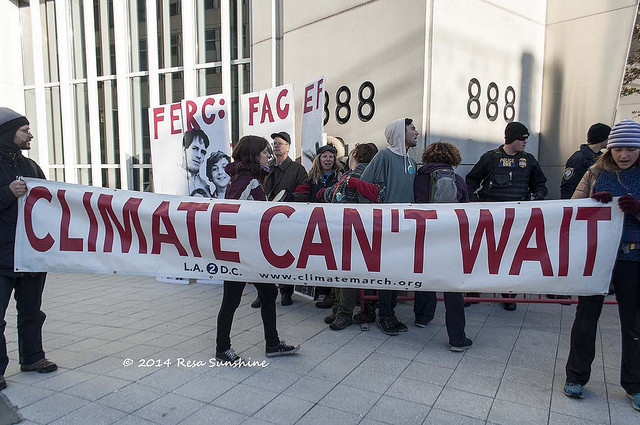
On December 10th the U.S. Bureau of Land Management plans to hold an auction for parcels of land in Michigan and Arkansas. The purpose? Leasing by the federal government of publicly owned lands to private companies, often resulting in drilling for oil and gas.

According to the National Wildlife Federation, the American public collectively owns nearly 650 million acres of public land and the fossil fuels beneath it. It also owns more than 1.7 billion acres of Outer Continental Shelf lands that also contain oil and gas resources.  The government holds these auctions regularly, but the upcoming auction on December 10th conspicuously coincides with the final days of the U.N. Climate Summit in Paris.  As a result, the Keep it in the Ground movement is trying to pressure President Obama to cancel this auction.

Keep it in the Ground is a movement of environmental organizations that are aiming to slow climate change by keeping remaining fossil fuels in the ground, instead of available for burning and drilling. The participating organizations include large groups such as 350.org, CREDO, the Indigenous Environmental Network and Greenpeace USA. The movement has been successful in getting the support of seven Democratic senators, including Democratic presidential candidate Bernie Sanders. These senators have introduced the Keep It in the Ground Act which came after organizations associated with the movement sent signed a letter addressed to President Obama urging him to stop new federal leasing of fossil fuels.

Jason Kowalski, U.S. policy director at 350.org, has criticized the president for allowing federal leasing auctions to continue while rallying other nations to fight against climate change. “Here we are, negotiating a climate treaty in Paris, and the core point of this treaty is keeping fossil fuels in the ground,” Kowalski told Mashable. “In the midst of that, we’re holding an auction, and the government itself is selling fossil fuels to the highest bidder?”

Obama has cited the need to keep some fossil fuels unburned, and on Nov. 6, he rejected the Keystone XL oil pipeline, a landmark decision seen as a major victory for environmentalists. “They’ve been bragging about it in Paris,” Kowalski said. “…but it’s really hypocritical to be bragging about the Keystone decision in Paris and at the same time be selling fossil fuels to the highest bidder in Washington, D.C., during the final days of negotiations.”

If Obama does not cancel the Dec. 10 auction, groups associated with the Keep it in the Ground movement are planning to hold a rally and press conference outside of the auction site on that date.


Article via Mashable, 3 December 2015

Photo: FERC Protest via A Jones [Creative Commons Attribution-NonCommercial-NoDerivs]

The National Security Agency has been collecting metadata, which is information such as phone numbers and duration of calls, since shortly after the attacks of September 11. The collection of this metadata has ceased as of November 28th. So what changed?

There is a new law in place, known as the USA Freedom Act of 2015. This law is being seen as a victory for privacy activists and tech companies looking to protect their user data. The USA Freedom Act of 2015 came about as a response to the revelations of Edward Snowden, a former NSA contractor that revealed the deep surveillance of the NSA on the American people. This new law prohibits the bulk collection of phone data previously done by the NSA. Although the agency won’t keep the bulk data, investigators will still have access to these types of records when they are investigating a particular person, or targeting specific groups. The existing metadata that has been captured during the last 5 years will be kept until next February 29th in order to ensure a smooth transition.

National Security Council spokesperson Ned Price stated that this new law, “struck a reasonable compromise which allows us to protect the country while implementing various reforms”.

Some have concerns, since the new law is going into effect so soon after the terrorist attacks in Paris. At a time when America is scaling back its surveillance, countries like England and France are considering new bills to enhance surveillance. Since American companies like Verizon would be involved, it may mean the creation of new treaties between Great Britain and the United States.  It is likely that this type of confounding circumstance will present itself more in the future due to the international nature of terrorism.

Article via ABAJournal, 30 November 2015

Photo: National Security Agency Seal via Donkey Hotey [Creative Commons Attribution-NonCommercial-NoDerivs]

If you haven’t heard of TED yet, it’s a nonprofit organization devoted to Ideas Worth Spreading. The main conference is held in California and was started 25 years ago, and it’s influence has been growing exponentially since then. All other TED events are called TEDx and are independently organized TED-like events with the same mission. These events often discuss science, technology, education and communication and have been known to spark innovation and social change by  providing the opportunity to shed light on less known facts and causes that are happening at a  local level.

I had the pleasure of attending the TEDxHouston 2015 event this year, where there were several talks  highlighting themes of social change, innovation and technology.

Teresa O’Donnell, Founder of  Plant It Forward  , spoke of her professional life as an entrepreneur. In an effort to do more community work through her company, she studied and became more informed on the plight of refugees coming to America.  For those who seek refuge in this country, it takes a minimum of 5 years to achieve that status. A refugee must prove that conditions in their  home country are incredibly difficult (persecution and war)and that it  has become impossible for them to return home without fearing for their lives. Houston, Texas in particular has received a large number of these refugees. Once the refugees arrive in the United States, they face the confounding problem of not speaking the dominant language, as well as not having transferable work skills.

To solve this problem, Plant It Forward partners with social and church groups to provide land and tools to refugees who settle in Houston with few other skills besides farming. Houston now has a growing community of organic gardens that sell  fresh fruit farmed by refugees at local farmers markets. Through Plant It Forward farms, refugees have the opportunity to build a life for themselves and their family while enriching the city with their farming skills.

Enriching the city was a theme that arose continually throughout the day. Susan Rogers focused on  community development and city planning; she works as a designer, professor and director of the Community Design Resource Center (CDRC) in Houston. The CDRC’s  goal is to use design to enhance change in the community and are focused on serving the public interest by improving the development of all communities. She spoke specifically about the economic disparities existing between the eastern and western half of the city, and how this is reflected in the design and therefore service of the communities. By preserving the culture and uniqueness of all neighborhoods, it improves other public services that cater to their residents, thereby raising the standard of life for all.

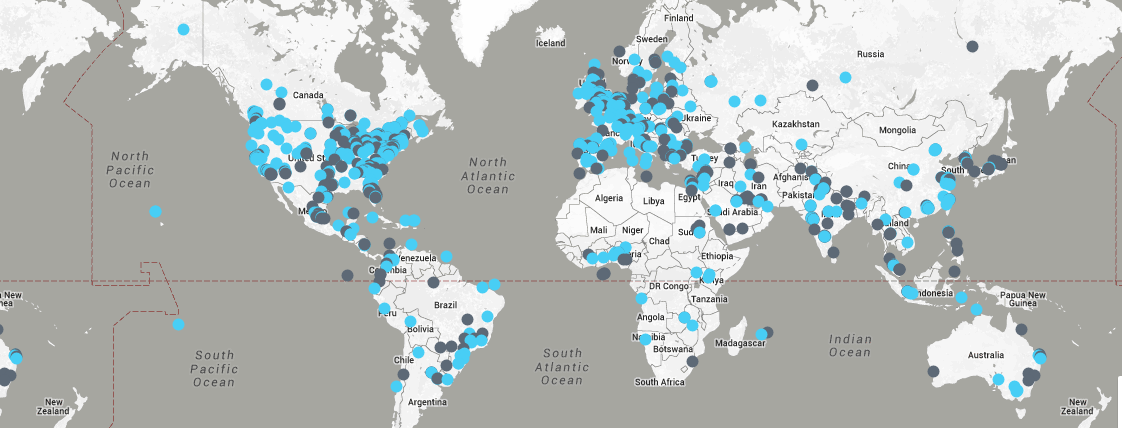
Talks like these are not just  happening in the United States, they happen all over the world. In 2015 there are over 3000 Ted events scheduled with talks about everything from education, to medicine, to life and career.

TED around the world

If you don’t have time to attend a TED event, you can easily watch a recording which is  available for free at TED.com. Talks are even arranged by topic and influence in convenient playlists.

The true power of TED comes from the opportunity to see the world through someone else’s eyes, and become aware of possibilities that you may not have known existed. TED provides a platform to bring to light issues that are too often not discussed and gives insight into the wonder of the human spirit,  reminding us how truly amazing it is to reimagine the world the way that we believe it should be.

Photo via: Ted.com