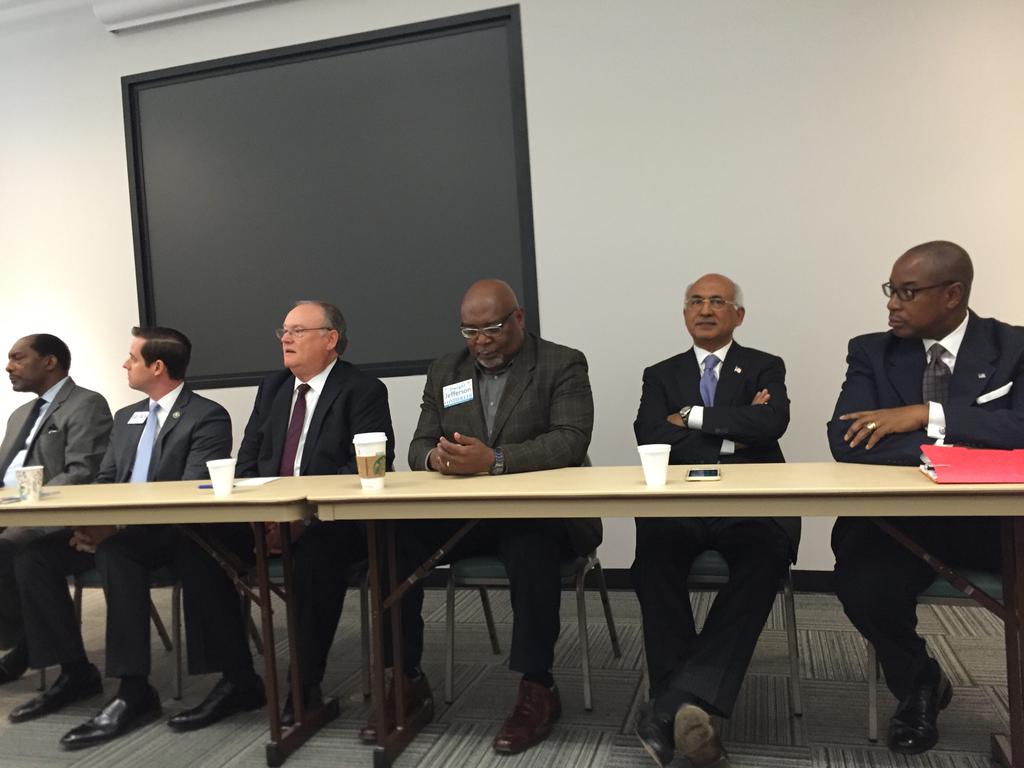
The Houston Controller Debate on Technology took place early this October at the Houston Technology Center, which was hosted by The League of Women Voters.  The topic of discussion was how technology could be used to bring the city’s controller office out of the 90’s and make spending transparent for the citizens of Houston. The city controller is similar to a chief financial officer for city government. The current city controller, Ronald Green, is not seeking re-election due to term limitations. There are currently 6 candidates running to take his place.

The room is filled with an array of people and there is a clear mix of older professionals and younger technologists. The candidates are all seated along a long table, facing outwards to the audience. This group is all male and appear to be ranging in age and experience. From left to right they start to answer questions posed from the moderator.

The first to respond is Jew Don Boney. He has a history of working on the Houston City Council and seems clear on how to integrate new technology into the system. Boney also served as mayor pro-tem under Mayor Lee Brown and represented District D, a predominantly African-American district. Currently he is an administrator at Texas Southern University.

The next candidate is Chris Brown. He is currently Deputy City Controller for Houston. Brown, the son of former City Councilman and mayoral candidate Peter Brown, has stated that his experience in the private sector working for an investment bank and his 11 years of service at the City of Houston make him the right person for the job.

Next to speak is Bill Frazer. He is a past President of the Houston CPA Society and has served on the Board of Directors of the Texas Society of CPAs for the past 20 years. Frazer is concerned with making sure that the controller’s actions are transparent and easy for the public to understand. He is interested in cleaning up the budget and making sure that the controller’s office is orderly and functioning as any accountant would.

Seated next to Frazer is MJ Khan. As a councilman, Khan proposed “Zero-Based Budgeting” for All city departments. He focused on unfunded liabilities in Houston’s Pension Systems and Retirees’ Health Benefits. Khan is also focusing on fighting for more efficiency in city government.

The next candidate to speak is Dwight Jefferson. Mr. Jefferson left his position at METRO to run for city council. He is a former district court judge with a long history of working in city government and with Metro.

The last on the panel to speak is Carroll Robinson. Mr. Robinson is an associate professor at Texas Southern University. Mr. Robinson, like many others on the panel has a long history working on the Houston City Council.

Although many issues are brought up, it always comes back to the current financial problems the city is facing, and how this can be avoided in the future. The city has a big deficit, and this has caused problems with making pension payments and beneficial spending. Several of the candidates bring up ways that the city’s website can be improved to make spending more transparent. According to the panel of candidates, the public needs an easy way to see the current status of the budget. Should the website updates an online check to allow the public to keep track of spending? Maybe the site should use a dynamic spreadsheet? Several solutions are posed by the candidates, but none are detailed enough to truly envision implementing.

This begs the question, how can the public get more involved? Houston is the not first major city that has needed to find innovative ways to bring in more technology to their processes. New York City created a new position of CTO (chief technology officer) who runs the Mayor’s Office of Technology and Innovation. The sole purpose of this office is citywide collaboration on technology issues. The city of Chicago has a Department of Innovation and Technology who looks for ways to bring in innovation to their government system. Even the White House is embracing innovation through technology. They made headlines when the nation’s first Chief Data Scientist was announced.

Jayson White from Harvard’s Kennedy School says that the focus of innovation positions in government started with education reform and sustainability. But, once the recession hit, that focus shifted to budgets, economic development, and job creation. The true benefit of having Chief Technology Officers and Chief Innovation Officers is the data driven management that they employ. One example is Louisville-Jefferson County, Kentucky. By incorporating innovation and information officers into the city government, problem solving starts with rounding up data. In turn, they have come up with interesting solutions, such as cutting down on 911 emergency trips by having nurses in the dispatch room to help determine if there is really a medical emergency or if the caller may need to go to the drug store. Now the city is accessing the data on non-emergency calls to determine if there is a market for private-sector transportation service to drive people who call 911 for non emergency transportation.

Starting with the Houston Hackathon, technology innovation is beginning to become a reality. The opportunity to bring innovation to city government structures gives the public a chance to get involved directly with the local government. The City of Houston has created an open hackathon to get citizens involved in creating solutions to government problems. Groups like Open Houston have been putting on hackathons to bring out developers, designers, marketers and others to get unique solutions to some of our city’s problems. Houston’s Mayor, Annise Parker, has made data more open to the public to encourage citizen innovation.

During the Q&A, the audience seemed interested in bridging the gap between citizens and government. Although all the candidates have amazing depth of experience and knowledge of local government, none are experienced technologists. This election is an opportunity for Houston voters to make technology an important issue. So far, a clear plan has not been established for the city to incorporate new technologies that will solve finance and transparency problems. This leaves a huge opportunity for citizens to come up with their own solution. Make sure that you vote for Houston Controller on Tuesday, November 3rd.

Photo via Justin Conception

Lawyers, like everyone else, have been quick to adapt to use of smartphones for business use. Having a little computer in your  pocket that is attached to the internet makes it easy for lawyers to reach and respond to clients and keep up with industry news. Law firms have become dependent on this technology and as a result smartphones have become a ubiquitous device. Since the time of the reign of blackberry, lawyers have been handed smartphones for company use on a regular basis.

But what is happening to these phones once the firms are done with them? More specifically, what is happening to all the client data that is collected on these phones while they were in use? Large firms usually have an enterprise solution for handling old smartphones. But it is less likely that the same is the case with smaller firms.

A recent study by the Blanco Technology Group revealed that data is sometimes left behind on second hand devices. They found that one-third of discarded smartphones had residual data left on them. Of the mobile devices with residual data, over half was left there after an attempted deletion. This means that even for those who were trying to protect their data by deleting it, they were unsuccessful and did not realize it.

For lawyers, this type of liability can make the stakes much higher. Possibly leaving confidential client information on a device can be extremely detrimental. This means that law firms, large and small, will need to take extra steps to make sure that their mobile devices are wiped clean. This includes not just smartphones, but also tablets and hard drives as well.

Lawyers will need to upgrade their tech savvy to make sure that their data and their clients stay safe.

Article via Above The Law, 8 October 2015

Photo: The iphone 4 via Jorge Quinteros [Creative Commons Attribution-NonCommercial-NoDerivs]

A disbarred New Mexico Judge is refusing to step down after being disbarred.

Corrales Municipal Judge Luis Quintana was disbarred on July 1st by the New Mexico supreme court. The disbarment was for failing to turn over a settlement check to a client from a workers compensation case. The complaint was filed by Maria Ramos, one of the Judge’s former clients. A committee found that he used the money to pay debts that he owed to other clients instead of paying Ms. Ramos. The Judge contends that his disbarment has nothing to do with his job, therefore he has no intention of resigning.

Judge Quintana told the Albuquerque Journal that the case that resulted in the courts decision to disbar him happened before he was elected. Because of this, Quintana states that he is fully able to carry out his term, which ends in 2016. Despite his claims, the Judge is facing pressure to resign.

“People like myself who are lawyers or retired lawyers are quite alarmed, not only that it happened, but that it’s taken several months for it to become public knowledge…”, says Mayor Phil Gasteyer.  Mayor Gasteyer raised the issue of the disbarred Judge at a recent meeting of the village council. Since Quintana was elected to his position as Judge, he cannot be forced to vacate it. The Mayor plans to ask Judge Quintana for his resignation.

In response to the controversy Quintana stated, “Are people going to be disappointed? Sure. I’m disappointed, too. I’m disappointed because I didn’t serve Ms. Ramos as great as I should have, you know. But that was one instance in 30 years.”


Article via ABAJournal, 7 October 2015

Photo: Judges Desk Partial Desat via Matthew Paulson[Creative Commons Attribution-NonCommercial-NoDerivs]

Edward Snowden fled the US in 2013 after leaking classified documents to reporters. These documents revealed domestic surveillance by the NSA on United States citizens and ignited outrage and debate about security and surveillance. To escape arrest, Snowden left the country and resides in Russia, where he has been since 2013. Now he wants to come back home.

In an interview that aired Monday with the BBC, Snowden says that he has offered to go to jail in exchange for coming home, but has not received a response from the government. He stated, “I’ve volunteered to go to prison with the government many times”. He continues saying that “what I won’t do is I won’t serve as a deterrent to people trying to do the right thing in difficult situations.” This echoes a sentiment that he expressed in a Wired interview in 2014 where he said that he wouldn’t mind going to jail as long as his sentence “serves the right purpose.”

Snowden has been charged with 3 felonies in accordance to the Espionage act that  carry a sentence of over 30 years. His lawyers have objected to Snowden returning to the US because they believe that a trial with charges under the espionage act would not be fair. “The Espionage Act finds anyone guilty who provides any information to the public, regardless of whether it is right or wrong,” Snowden told the BBC. “You aren’t even allowed to explain to a jury what your motivations were for revealing this information. It is simply a question of, ‘Did you reveal information?’ If yes, you go to prison for the rest of your life.”

There continues to be ongoing debate as to whether Snowden is a patriot or a traitor. Those who see his actions as an act of patriotism have called for President Obama to grant Snowden a full pardon. But, when Secretary of State John Kerry visited Moscow in 2013 he called Snowden a traitor and a coward. Former Attorney General Eric Holder has indicated that a plea deal could be possible that can met the request of both the government and Snowden.

In the meantime, Snowden continues to use his status to speak out about issues of security and surveillance.

Article via TechCrunch, 6 October 2015

Photo: snowden via duluoz cats[Creative Commons Attribution-NonCommercial-NoDerivs]

Gone are the days when law firms could rely on business from traditional sources. Due to the financial crisis in 2008, many law firms are still operating on a leaner staff and are looking for ways to cut expenses. To mitigate this need firms are looking to grow their expertise by connecting with outside experts, while also lowering their costs. In the information age, this means relying more on external digital sources for research instead of traditional in house law libraries.

Many prominent law firms have cut their costs by shrinking the size of their law library. In this leaner model, law firms cannot afford the costs of duplicate content and a buffet style approach to purchasing information. The demand for sophisticated research has increased, making law firms more dependent on access to vast amounts of content.

Two venders, LexisNexis and Westlaw are leading the market of law firms looking to meet the high information demand. As outsourcing has become more accepted in the legal community, there are more new companies coming aboard to meet legal information needs. Outsourced consultants are valuable to law firms because they can deliver high level services and expertise at scale. The companies allow law firms to take advantage of both broad and deep information, along with industry expertise, something that in house libraries alone cannot match.

For law firms, this means a lower administrative burden while increasing efficiency. As law firms conform and adjust to a changing market and economy, these services offer a means of staying relevant and competitive.


Article via LegalTechNews, 1 October 2015

Photo: law books via  Mr.TinDC [Creative Commons Attribution-NonCommercial-NoDerivs]


Microsoft and Google agreed Wednesday to dismiss nearly 20 patent related lawsuits that they have pending against one another.

The two rivals have filed lawsuits against each other for the last 5 years over royalties related to wi-fi, smartphones and web video. The core of these lawsuits has been an ongoing fight over the use of  patents. Both Google and Microsoft have fought viciously to use patents owned by the one another, and to collect royalties for their use.

The patent disagreement started in 2010 when Microsoft filed suit against Motorola, which was acquired by Google the following year. Microsoft, like other prominent software companies, licenses patents from Google for various products and devices. Microsoft’s suit alleged that Android devices infringed on Microsoft patents and that Motorola was charging excessively for the royalties. Google fought back claiming that Motorola’s royalty rates were fair.

In 2013, Microsoft won its case against Motorola and got the royalty rate reduced to 22 times lower than Motorola was charging.

Neither company disclosed the settlement to end their patent feud, but they did say that they “agreed to collaborate on certain patent matters and anticipate working together in other areas in the future to benefit our customers.”


Article via CNET, 30 September 2015

Photo: Google Campus Mountain View, CA via Eric Langhorst[Creative Commons Attribution-NonCommercial-NoDerivs]