
More and more evidence is being brought to light that competent lawyers need to be able to understand technology to truly be considered competent. Take Model Rule 1.1 as set forth by the ABA, for example. Even though states are not required to include Model Rules in their regulations for lawyers, 49 states have adopted Model Rule 1.1, which states that lawyers must be able to provide competent knowledge to their clients. To be able to provide competent knowledge, the lawyers themselves must fully understand the advice they are imparting. Comment 8, an addition to Model Rule 1.1, addresses the fact that lawyers need to continually educate themselves on the technology relevant to their practice if they are to be considered competent enough to advise on it. While not every state has adopted Comment 8, it is being slowly incorporated by a list of states, a list which will likely grow in the future.

Outside of Comment 8, lawyers are starting to have to deal with issues such as cloud computing and metadata, which often require not only tech advice from experts but also knowledge about ethics regulations. Sometimes permission from regulators must be obtained in order to ask experts. To avoid potential problems, lawyers should look into the opinions on the ethics surrounding each type of technology that have been expressed by their state, which can be found on the ABA’s website. Outside the realm of ethics, many states have expressed opinions on what technological knowledge should be required for lawyers. In 2014, for example, the California Committee on Professional Responsibility and Conduct stated in their Formal Opinion 2015 that although issues like e-discovery are new, the idea of competency is not, and competent lawyers need to be knowledgeable since “in today’s technological world, every case has the potential to involve e-discovery.”

The world is evolving, and law is starting to catch up as formal regulations are set around technological knowledge. To truly stay competent, lawyers need to be familiar with using technology and stay up to date on the latest news surrounding technology with which their clients may be involved.

Article via The Lawyerist, September 10, 2015

Photo: iPublishing, iReading, iEnjoying via Charis Tsevis [Creative Commons Attribution-NonCommercial-NoDerivs]

Facebook and the United Nations are working together to provide Internet access to Syrian refugees as they seek resettlement. Web access in refugee camps will help those living there communicate with family and utilize support from aid communities, according to Facebook’s CEO Mark Zuckerberg.

Facebook is also constructing satellites and aircraft that will beam Internet connections to remote villages and towns, similar to Google’s project that accomplishes the same goal with high-altitude balloons. Critics to the program say that both companies are providing Internet access for selfish purposes, as both Facebook and Google profit from expanding their user base.

Facebook’s non-profit organization Internet.org is also under attack. Internet.org seeks to provide Internet access to developing countries, and was launched in India on Friday. Several Internet companies withdrew from the program because they saw the organization as a threat to Net neutrality, which guarantees that all websites are equally accessible.

Zuckerberg will be holding a town hall-style discussion with India’s prime minister this Sunday in defense of the non-profit. He says that by expanding Internet access, companies like Facebook and Google can create 140 million new jobs.

Article via CNETSeptember 26, 2015

Photo: Relief Effort for Syrian Refugees via IHH Humanitarian Relief Foundation [Creative Commons Attribution-NonCommercial-NoDerivs]

Google appealed EU’s “right to be forgotten” law that allows citizens to apply for the removal of false or damaging information indexed by search engines. Although the company is willing to comply by the law for European domains, like Google.fr, France’s data regulation authority (CNIL) ordered Google to comply by the law for its international domain, Google.com.

If Google refuses, the company may suffer significant fines or sanctions. Google officials argue that applying the EU’s “right to be forgotten” rule to its international server is both time and resource consuming, and may result in widespread censorship. Google does not have the right to appeal again until it has been fined for violating the CNIL order. After that, however, the company will be given the chance to refute the fines in France’s Supreme Court. The EU’s recent regulatory fine structure could charge Google for up to 5 percent of the company’s international operation cost, which would amount to roughly € 3 billion.

Google’s global privacy officer Peter Fleischer released a statement: “We believe that no country should have the authority to control what content someone in a second country can access.”

Article via Legaltech NewsSeptember 22, 2015

Photo: Review of the Latvian Presidency via European Parliament [Creative Commons Attribution-NonCommercial-NoDerivs]

A southern California company and former AT&T sales reps are being sued by AT&T Mobility. They are accused of uploading malicious software to unlock phones so that the phones can be used by any wireless network without a contract. It is likely that the sales reps were hoping to exploit the resale market for cell phones.

Lawyers for AT&T Mobility stated that schemes like this are not uncommon. The lawsuit names SwiftUnlocks, as the southern California company referenced above. This is a company that unlocks cell phones for a fee. The lawsuit goes on to describe a scheme that involves the former sales reps profiting from using SwiftUnlocks to unlock phones in milliseconds. It was precisely the act of unlocking many phones so quickly, that drew attention to these sales reps, eventually promoting an investigation.

It is alleged that the former reps earned between $10,000 and $20,000 from Swift Unlocks before tipping off their bosses with their questionable behavior.

Although the suit does not mention criminal fraud, it could still prove expensive for Swift Unlocks and the former sales reps. It is expected that the damages would include lost profit as well as factoring in the revenue that the sales reps made during their alleged scheme.

Article via CNET, 19 September 2015

Photo: This trip to the at&t store is taking longer than I expected via Keith Lam [Creative Commons Attribution-NonCommercial-NoDerivs]

Recent hackings have been found to especially target three main platforms: healthcare, education, and government. This has compromised the security of healthcare provider Excellus BlueCross BlueShield, the Cal State University System, and the U.S. Department of Energy.

It was discovered last week that over 10 million people are at risk due to a Excellus computer system hacking that’s been occurring since December of 2013. It doesn’t appear that the hackers stole or utilized any important personal information, though they were able to access and view customer names, birth dates, social security numbers, and financial claims. The attack was one of the worst 20 breaches in healthcare of all time. The hacking also parallels recent incidences at Anthem, Office of personnel Management, Sony and Ashley Madison. In all cases, the attacks were committed by people disguised as employees, using stolen credentials to gain access to corporate networks.

Roughly 80,000 students from the Cal State University System lost general information after enrolling in a class on sexual harassment. Their names, numbers, emails, gender, race, and relationship status were provided to a contractor as part of a program on sexual harassment. The contractor, “We End Violence” was hacked, as reported in the Los Angeles Times earlier this month.

The U.S. Department of Energy’s computer systems were attacked 159 times between 2010 and 2014. Officials declined to comment, however, on the nature of what was accessed by hackers or whether any foreign governments were responsible.

Article via ECT News NetworkSeptember 16, 2015

Photo: Longmont Power and Communications-3 via You Belong in Longmont [Creative Commons Attribution-NonCommercial-NoDerivs]
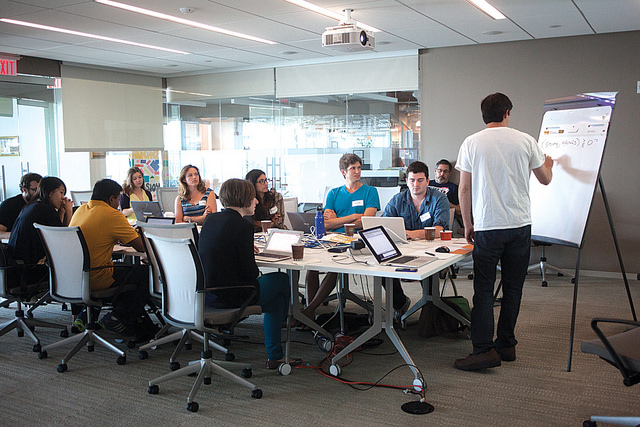
Hackathons have proven to be a great way to use tech for good. Often described as a great equalizer, technology can be leveraged to bring voice to people that society often ignores. Social activists are turning to hackathons to help spread their message and develop solutions, instead of waiting on the government to initiate change.

One such activist is Hera Hussain, founder of the advocacy group Chayn. Chayn is a volunteer-led, open source project that leverages technology to empower women against violence and oppression so they can live happier and healthier lives. They offer tools to help abused women build a domestic violence case without a lawyer, and advise about how a person can be tracked on and offline, among other things. This organization is all about individuals empowered to make change. One of their main ways to get the community involved is hackathons.

Hussain says that hackathons are events that bring together important parts of society that isolate themselves when it comes to women’s issues. “You either have events that just focus on women…” Hussain says, “or you have events that are completely dominated by men and are either forgetting that women exist or have separate issues. There’s very little middle ground that uses an integrated women lens as part of a broader focus of solving societal challenges.”

Bringing together these problem solvers is crucial to making real progress in the future. Hussain states that Chayn is about solving problems with, and not for, women in different communities. This organization is dedicated to allowing women to choose what they want to do with their lives while being treated equally during the process. Hussain says, “We always come back to independence and happiness as our two biggest goals..”

Article via Good Magazine, 22 September 2015

Photo: Hacking for Women’s Empowerment via Bread For The World [Creative Commons Attribution-NonCommercial-NoDerivs]