Recently President Obama got a Facebook page. The reason he stated was to make it easier for the public to have access to the president. He also wanted to have more conversations with real people. Using social media to make connections and grow relationships is a  great way to harness the power of a social media presence. For a lawyer, social media can be a way to be more visible and to reach more clients.

The goal of social media is to get noticed. In the social media world, it means being at the forefront of people’s mind. You can achieve that by making posts that stand out in people’s feeds. The trick is to say things that are interesting to  your followers so that they repost your content. In this post, we will look at ways that social media can help your business.

  1. Social media is an easy way to learn your audience. No matter the industry, it is always beneficial to have insight into who is interested in your product or service. Using social media will allow you to build an audience. As this audience builds you can use tools like google analytics. This allows you to see information about your audience like their age, location, and what posts are being read the most.
  2. Social media can help increase traffic to your website. Many law firms have a site showcasing their business. Having active social media accounts with good content can help drive people to your website. In addition to helping drive new customers to your site, it will also increase your rank in search engines making it easier for other new clients to find you.
  3. Social media helps generate leads for one third the cost. Outside of creating content in the form of posts and picture, you can use social media to advertise your business. Facebook ads and twitter ads allow a firm to easily reach a large audience for a very low price. Advertising starts on some platforms at just 5 dollars. Analytics associated with advertising can be reviewed with known data about your audience so that ads can be targeted to specific audiences.

Social media is fast and delivers news and updates at a record pace. It is also a great way to build your brand and make your clients aware that your firm exists. Don’t over look using social media as a means of improving your relationships with current and future clients.

Photo: social media class via mkhmarketing [Creative Commons Attribution-NonCommercial-NoDerivs]

In the wake of the recent terrorist attacks in Paris, French law enforcement is considering banning public wi-fi. According to leaked documents by the French Ministry of the Interior, law enforcement wants to secure the Tor network when a state of emergency is declared by banning the use of the public wi-fi all together. The French newspaper La Monde  is said to have leaked the documents.

The city of Paris currently has over 300 locations that are serviced by public wi-fi and the Tor network. French law enforcement believes that public networks makes it harder to catch suspected terrorists who might be using the network to communicate to each other. The Tor network allows anonymity online and has also been used as a secure network for a drug marketplace. It is currently unclear if the Tor network was used during the Paris attacks and French law enforcement authorities are cautious about its possible use for ISIS communication in the future.

Blocking the Tor network completely would present a challenge for the French government. China is the only country that blocks Tor outright. To achieve this, the Chinese government has to block public entry nodes to the Tor network. In addition, China has to lookout for secret entry nodes. Unlike China, France promotes online freedom for its citizens. Therefore blocking the Tor network would infringe on the rights of French citizens. Since French law enforcement does not know if blocking Tor will have an effect on the ability for terrorist groups to communicate, it is a big risk. Encrypted social media chat apps like WhatsApp, in theory, are easier ways for terrorist groups to communicate without worrying about interference from the government.

The debate over privacy and national security seems to have just gotten started. New legislation that includes these stipulations may be presented to the French Parliament as early as January 2016. 

Article via Mashable, 8 December 2015

Photo: Paris November 2015 via Roberto Maldeno [Creative Commons Attribution-NonCommercial-NoDerivs]

According to the International Telecommunication Union, there are about 3.2 billion people online. Mobile networks are leading the way to connecting people for the next generation of communications. There are about 7.1 billion subscriptions globally and 95% of people in the world are within reach of a mobile network signal.

The Republic of Korea leads the world as the most-connected place. European countries along with Southeast Asia countries Japan and China follow afterwards. The United States comes at #15. This is with respect to Internet connectivity and how well data services are adopted in that country. The list below does not correlate with how fast the country’s economy is growing. Rather, it correlates with how many people have online access in that country.

Photo via TechCrunch

Photo Credit: TechCrunch

The downside of this news is that there are still about 350 million without Internet access. These include people in some of the poorest countries in the world, such as Malawi, Madagascar, Ethiopia, Eritrea and Chad, which are the five least-connected countries globally in descending order. These countries are referred to as least developed countries, or LDCs.  Projects such as Project Loon by Google and “Free Basics” by Facebook are attempting to resolve this extreme gap.

There has been an improvement of the “middle class” countries pertaining to the Information and Communication Technology (ICT) Developmental Index (IDI) growth. Universal online access contributes to globalization.

Article via TechCrunch, Nov 30, 2015

Photo: Vardøger [Déjà Vu] by Chris JL [Creative Commons Attribution-NonCommercial-NoDerivs]


Though it may seem that support for more legal aid would mostly arise from the liberal side of politics, both Republican and Democratic representatives have come together to establish a new legal aid caucus. The caucus, entitled “Access to Civil Legal Services Caucus”, was announced by Representatives Joe Kennedy III from Massachusetts and Susan Brooks from Indiana. Their goal is focused around “expanding access to legal representation for low-income families” including “…veterans, and victims of domestic abuse.” Ensuring that legal services are accessible is extremely important because without it, individuals “can face enormous burdens that devastate families, result in a further descent into poverty, and cause homelessness.”

Additionally, the caucus will focus on making sure there is enough funding for legal aid at the national level. Lack of funding is a serious issue; in 2013, 64% of cases that were eligible for legal aid in Massachusetts were turned away because organizations simply didn’t have enough funding. Representative Kennedy hopes that the caucus will “build a strong coalition in Congress to advocate for civil legal aid programs and ensure access to representation is never limited by income.”

Article via Above the Law, December 8, 2015

Photo: Capitol Hill, Washington DC via Toni Syvänen [Creative Commons Attribution-NonCommercial-NoDerivs]

In his address this past Sunday on his plan to deal with ISIS, President Obama stated that he will be meeting with social media giants like Facebook and Twitter to talk about their anti-terrorism efforts. Specifically, the Obama administration wants to create a “clearer understanding of when we believe social media is being used actively and operationally to promote terrorism,” according to what one White House official told ReutersWhile social media powerhouses already have policies concerning terrorism and hate speech, allowing government demands to interfere with social media could potentially go against free speech and user privacy.

Social media powerhouses are already combating terrorism. Collectively, Facebook, Youtube, and Twitter have taken down more posts this year than in previous years. Therefore, any hesitancy from social media to remove encryption that allows users to retain their privacy online shouldn’t be viewed as supporting extremist ideology. In fact, a former employee of a social media company who chose to remained unnamed told Reuters that social media may be working with Western governments more than you think. Even though some social media companies state that they do expedite the removal of content based on government complaints, the former employee revealed that direct channels for government complaints exist to get rid of certain content quickly.

Finding the balance between using social media as a way to prevent terrorism while still protecting user privacy is simply another part of the ongoing debate of security versus privacy.

Article via CNETDecember 7, 2015; ReutersDecember 6, 2015; ReutersDecember 7, 2015

Photo: Twitter Follower Mosaic via Joe Lazarus [Creative Commons Attribution-NonCommercial-NoDerivs]

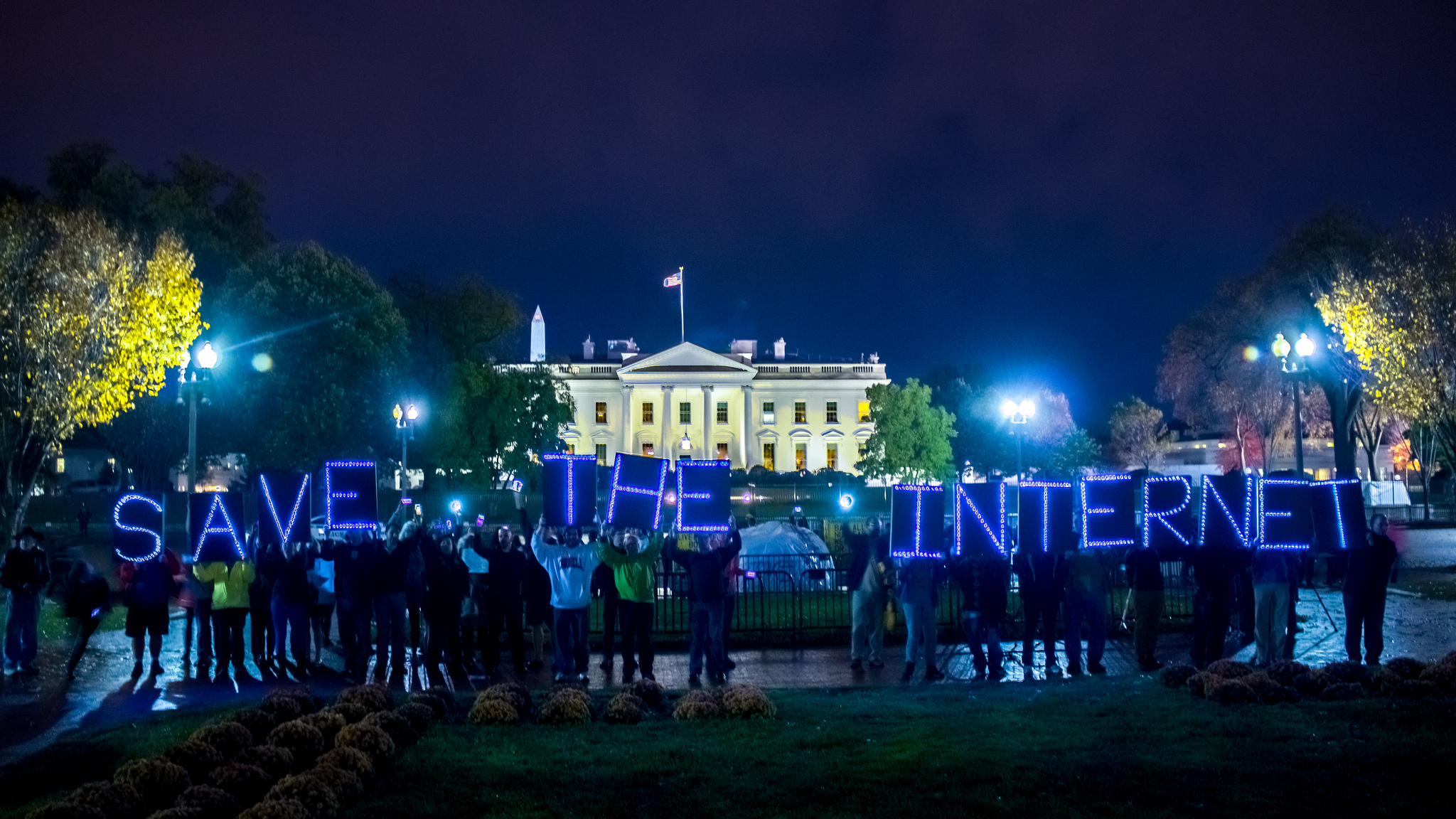
The concept of an “open internet”, or net neutrality, keeps internet service providers , or ISPs, from being able to alter how users are able to access web content. Specifically, it bans ISPs from being able to create internet “fast-lanes” or slow download speeds for web content that they wish to direct users away from. President Obama stated that he supports an “open internet” last year, three months before the Federal Communications Commission, or the FCC, was able to have rules enforcing net neutrality approved. Now, though, representatives from the telecommunications industry have come out in opposition of those rules, leading to the FCC to have to defend net neutrality in court this past Friday.

The FCC was originally able to get the “open internet” rules approved earlier this year by classifying ISPs as utility providers. This distinction gives the FCC more power to regulate ISPs. While the FCC believes that net neutrality supports businesses by keeping web services competitive, the telecommunications industry states that the new rules give the FCC too much control over the broadband market, hindering free enterprise instead of helping. Lawyers representing the views of the telecommunications industry argued that instead of being classified as utility providers, ISPs should be classified under information services, like Google. This classification would lessen the FCC’s ability so regulate ISPs and render the net neutrality rules inapplicable. The FCC argues, however, that without rules enforcing an “open internet”, ISPs will have too much power to promote certain web content over others. This could potentially hinder development and investment of new web content.

These arguments were presented to a panel of three judges who will release a decision in the spring which may approve or reject parts of the net neutrality rules.

Article via Buzzfeed, December 4, 2015

Photo: Protest at the White House for Net Neutrality via Joseph Gruber [Creative Commons Attribution-NonCommercial-NoDerivs]