
Even though there aren’t many jobs available for tech experts in the law profession, those that have experience in litigation support or e-discovery can expect to be able to obtain higher salaries than they have in the past, simply because there aren’t that many professionals out there that fit the criteria. It’s a simply case of supply and demand—with a limited supply of these tech professionals, they’re able to demand more money. For example, Robert Half predicts that litigation support/e-discovery directors can expect an approximately 6% increase on average in their salary, bringing the average range between $101,000 and $130,050. Tech professionals working in major markets such as New York can expect much more, though, with an average salary of $230,000 or more. Chief information officers can also expect to see an increase in their earnings, and their salaries can fall into the range of $300,000 to $500,000 at top law firms. As the global practice leader in law firm management at Major, Lindsey & Africa, Amanda K. Brady, explains, “It can be lucrative …. but there’s just not a lot of these jobs.”

As tech-related fields continue to grow, though, tech professionals can expect to see more opportunities for working in law. For example, multidisciplinary teams containing professionals knowledgeable about networks and information security are predicted to become more common for firms who have practice groups centering on cybersecurity or privacy. Additionally, many firms are expected to create practice groups for these kind of tech concerns if they have not already. With this much growth in the future, tech experts can look forward to salaries continuing to rise. According to Brady, “There’s only an upward projectory here. The demand will only continue.”

Though the prospect of a better salary may attract many tech professionals to law, they should keep in mind that the workplace culture found at a law firm can be very different from what they are used to. It isn’t entrepreneurial, like the environment found at a startup. Additionally, tech professionals, especially chief information officers, are often paid very well because technology can present a huge risk to the firm. If the tech systems are not kept up to par by the chief information officer and other tech employees, the firm’s reputation can suffer. Those looking to work in a law firm should keep the above in mind, but in addition to a higher salary, tech professional may also look forward to being involved in many different parts of the firms and handling many responsibilities.

Article via Legaltech News, September 25, 2015

Photo: Cash Money (part two) via Jeremy Yerse [Creative Commons Attribution-NonCommercial-NoDerivs]


Professor Tanina Rostain teaches the course “Technology, Innovation, and Legal Practice” at the Georgetown University Law Center. A fundamental part of it is a competition in which 4 teams of 3-4 students work together to design apps that advocates and lawyers can use to explore intricate areas of the law. The class has seen tremendous growth over the course of just 4 years.  With technology being a pivotal factor in today’s legal world, this course is ideal for law students who are interested in hands-on learning about the accessibility of important justice matters.

What began as a small project slowly spread out throughout the U.S. with involvement from organizations such as the Alaska Legal Services Corp and the U.S. Department of Justice. Its focus is centered on law as “an institution to help people”. One particular app, ADA2Go, was designed for people with disabilities to ascertain their rights in various situations.

Mark O’Brien, the executive director and co-founder of Pro Bono Net, says “Tanina has mastered getting students to do something that’s nonintuitive—the creation of specific apps during the course of a semester and delivering them to legal aid organizations and others for use.” Rostain herself said that “these apps are adaptable to a lot of paying legal work, and they’re going to proliferate.”

With the number of apps being created, the scope of the “access-to-justice” idea is already on its way to impacting many people in this profession and consumers themselves.

Article via ABA Journal, September 23, 2015

Photo: EP via European Parliament [Creative Commons Attribution-NonCommercial-NoDerivs]

Gone are the days when law firms could rely on business from traditional sources. Due to the financial crisis in 2008, many law firms are still operating on a leaner staff and are looking for ways to cut expenses. To mitigate this need firms are looking to grow their expertise by connecting with outside experts, while also lowering their costs. In the information age, this means relying more on external digital sources for research instead of traditional in house law libraries.

Many prominent law firms have cut their costs by shrinking the size of their law library. In this leaner model, law firms cannot afford the costs of duplicate content and a buffet style approach to purchasing information. The demand for sophisticated research has increased, making law firms more dependent on access to vast amounts of content.

Two venders, LexisNexis and Westlaw are leading the market of law firms looking to meet the high information demand. As outsourcing has become more accepted in the legal community, there are more new companies coming aboard to meet legal information needs. Outsourced consultants are valuable to law firms because they can deliver high level services and expertise at scale. The companies allow law firms to take advantage of both broad and deep information, along with industry expertise, something that in house libraries alone cannot match.

For law firms, this means a lower administrative burden while increasing efficiency. As law firms conform and adjust to a changing market and economy, these services offer a means of staying relevant and competitive.


Article via LegalTechNews, 1 October 2015

Photo: law books via  Mr.TinDC [Creative Commons Attribution-NonCommercial-NoDerivs]

 

Microsoft and Google agreed Wednesday to dismiss nearly 20 patent related lawsuits that they have pending against one another.

The two rivals have filed lawsuits against each other for the last 5 years over royalties related to wi-fi, smartphones and web video. The core of these lawsuits has been an ongoing fight over the use of  patents. Both Google and Microsoft have fought viciously to use patents owned by the one another, and to collect royalties for their use.

The patent disagreement started in 2010 when Microsoft filed suit against Motorola, which was acquired by Google the following year. Microsoft, like other prominent software companies, licenses patents from Google for various products and devices. Microsoft’s suit alleged that Android devices infringed on Microsoft patents and that Motorola was charging excessively for the royalties. Google fought back claiming that Motorola’s royalty rates were fair.

In 2013, Microsoft won its case against Motorola and got the royalty rate reduced to 22 times lower than Motorola was charging.

Neither company disclosed the settlement to end their patent feud, but they did say that they “agreed to collaborate on certain patent matters and anticipate working together in other areas in the future to benefit our customers.”


Article via CNET, 30 September 2015

Photo: Google Campus Mountain View, CA via Eric Langhorst[Creative Commons Attribution-NonCommercial-NoDerivs]

 

For parts of northwest Mohave County, Arizona, accessibility to court services used to be a problem. Surrounded by the Grand Canyon, the Colorado River, and the Virgin River Gorge, the closest court building is more than an hour away. This presents a problem for many of the locals. Mohave County has a high poverty rate and many low- and fixed-income residents, many of which have difficulty obtaining transportation. Thankfully, the IT staff of the Mohave County Superior Court under the direction of the court technology systems manager, Kyle Rimel, have been able to find a unique solution. By setting up the North Country Kiosk at a much closer DMV location, residents of Mohave County can now use video chat to obtain multiple court services. The presiding judge of the Mohave County Superior court, Charles W. Gurtler, says that, “The kiosk has been an absolute godsend as far as those people are concerned.” Among its features are the ability to access any courtroom in the county, pay fines, acquire forms, and even make filings or court appearances.

This isn’t the only way that Rimel and his staff are using technology to increase accessibility. Courthouse posters now include scannable bar codes so visitors can learn about jury and divorce information or receive directions. Additionally, an Internet chat line that provides access to court employees has been implemented, and the IT staff has outfitted nineteen courtrooms with audio-video equipment, allowing for different ways of presenting cases. Even though the Mohave Superior Court was woefully under-utilizing technology when Rimel first started working in 2003, he states that now, “our goal is to be one of the most technologically advanced courts in Arizona.”

For others looking to use technology to expand their court’s services, Rimel advises finding sponsors and realizing that courts may have to approach IT solutions differently than other entities. But the results are worth it: Gurtler has high praise for Rimel, calling him the “rock star of the IT world.”

Article via ABA JournalSeptember 16, 2015

Photo: Student pair video chatting with an ELL via Penn State [Creative Commons Attribution-NonCommercial-NoDerivs]
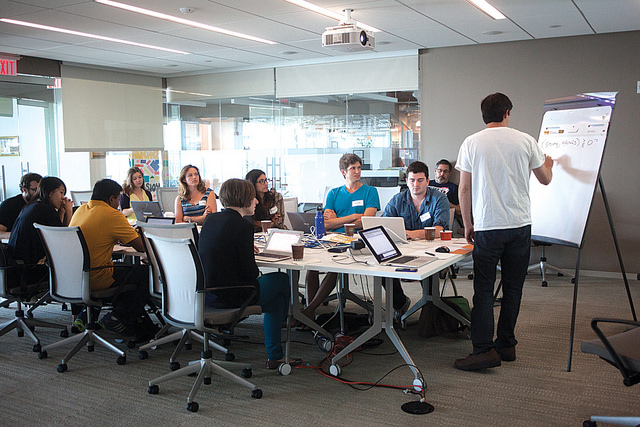
Hackathons have proven to be a great way to use tech for good. Often described as a great equalizer, technology can be leveraged to bring voice to people that society often ignores. Social activists are turning to hackathons to help spread their message and develop solutions, instead of waiting on the government to initiate change.

One such activist is Hera Hussain, founder of the advocacy group Chayn. Chayn is a volunteer-led, open source project that leverages technology to empower women against violence and oppression so they can live happier and healthier lives. They offer tools to help abused women build a domestic violence case without a lawyer, and advise about how a person can be tracked on and offline, among other things. This organization is all about individuals empowered to make change. One of their main ways to get the community involved is hackathons.

Hussain says that hackathons are events that bring together important parts of society that isolate themselves when it comes to women’s issues. “You either have events that just focus on women…” Hussain says, “or you have events that are completely dominated by men and are either forgetting that women exist or have separate issues. There’s very little middle ground that uses an integrated women lens as part of a broader focus of solving societal challenges.”

Bringing together these problem solvers is crucial to making real progress in the future. Hussain states that Chayn is about solving problems with, and not for, women in different communities. This organization is dedicated to allowing women to choose what they want to do with their lives while being treated equally during the process. Hussain says, “We always come back to independence and happiness as our two biggest goals..”

Article via Good Magazine, 22 September 2015

Photo: Hacking for Women’s Empowerment via Bread For The World [Creative Commons Attribution-NonCommercial-NoDerivs]