Google has been famously testing out their version of a driverless car. The company wants to transform transportation by taking the driver out of the equation.

Driverless cars will be able to shuttle people from place to place while reducing the human error that is often the catalyst for road accidents.The California Department of Motor Vehicles recently made a proposal of rules for driverless cars. These new rules were presented for public commentary in mid December of 2015. The DMV wants to involve the public and will be hosting two workshops early in 2016, one in Sacramento and the other in Los Angeles.This proposal draft is the next step in allowing driverless cars on California roads. But Google is unhappy about one of the provisions.

The regulators are calling for the manufacturers of driverless cars to meet several safety and performance standards. These include things such as protecting the privacy of operators from the needless collection of user data and having a third party independently access performance. The rules also call for a licensed human driver, capable of taking over the steering wheel and pedals in the event of an emergency. The problem is that Google’s prototype for a driverless car does not have a steering wheel or pedals.

Google’s maintains that it wants to improve safety by equipping the car itself with protocols that surpass what a human could detect. For instance their cars have sensors that detect objects as far as two football fields away–in all directions. The state of California is looking at the broader aspect of autonomous cars, and remains more conservative on the issue. They  have warned Google in the past to add steering wheels and pedals. California legislators pushed The DMV to require that driverless cars contain wheels and people to steer them whenever they’re operated on public roads.

Google is disappointed that California legislators are limiting the potential of fully autonomous vehicles, the company said. Although the company is still in the prototyping phase where changes can easily be made, it is still a setback.


Article via TechNewsWorld, 18th December 2015

Photo:Auto che guidano da sole. Forse non le vedremo mai sulle nostre strade by Automobile Italia [Creative Commons Attribution-NonCommercial-NoDerivs]

According to the International Telecommunication Union, there are about 3.2 billion people online. Mobile networks are leading the way to connecting people for the next generation of communications. There are about 7.1 billion subscriptions globally and 95% of people in the world are within reach of a mobile network signal.

The Republic of Korea leads the world as the most-connected place. European countries along with Southeast Asia countries Japan and China follow afterwards. The United States comes at #15. This is with respect to Internet connectivity and how well data services are adopted in that country. The list below does not correlate with how fast the country’s economy is growing. Rather, it correlates with how many people have online access in that country.

Photo via TechCrunch

Photo Credit: TechCrunch

The downside of this news is that there are still about 350 million without Internet access. These include people in some of the poorest countries in the world, such as Malawi, Madagascar, Ethiopia, Eritrea and Chad, which are the five least-connected countries globally in descending order. These countries are referred to as least developed countries, or LDCs.  Projects such as Project Loon by Google and “Free Basics” by Facebook are attempting to resolve this extreme gap.

There has been an improvement of the “middle class” countries pertaining to the Information and Communication Technology (ICT) Developmental Index (IDI) growth. Universal online access contributes to globalization.

Article via TechCrunch, Nov 30, 2015

Photo: Vardøger [Déjà Vu] by Chris JL [Creative Commons Attribution-NonCommercial-NoDerivs]


In his address this past Sunday on his plan to deal with ISIS, President Obama stated that he will be meeting with social media giants like Facebook and Twitter to talk about their anti-terrorism efforts. Specifically, the Obama administration wants to create a “clearer understanding of when we believe social media is being used actively and operationally to promote terrorism,” according to what one White House official told ReutersWhile social media powerhouses already have policies concerning terrorism and hate speech, allowing government demands to interfere with social media could potentially go against free speech and user privacy.

Social media powerhouses are already combating terrorism. Collectively, Facebook, Youtube, and Twitter have taken down more posts this year than in previous years. Therefore, any hesitancy from social media to remove encryption that allows users to retain their privacy online shouldn’t be viewed as supporting extremist ideology. In fact, a former employee of a social media company who chose to remained unnamed told Reuters that social media may be working with Western governments more than you think. Even though some social media companies state that they do expedite the removal of content based on government complaints, the former employee revealed that direct channels for government complaints exist to get rid of certain content quickly.

Finding the balance between using social media as a way to prevent terrorism while still protecting user privacy is simply another part of the ongoing debate of security versus privacy.

Article via CNETDecember 7, 2015; ReutersDecember 6, 2015; ReutersDecember 7, 2015

Photo: Twitter Follower Mosaic via Joe Lazarus [Creative Commons Attribution-NonCommercial-NoDerivs]

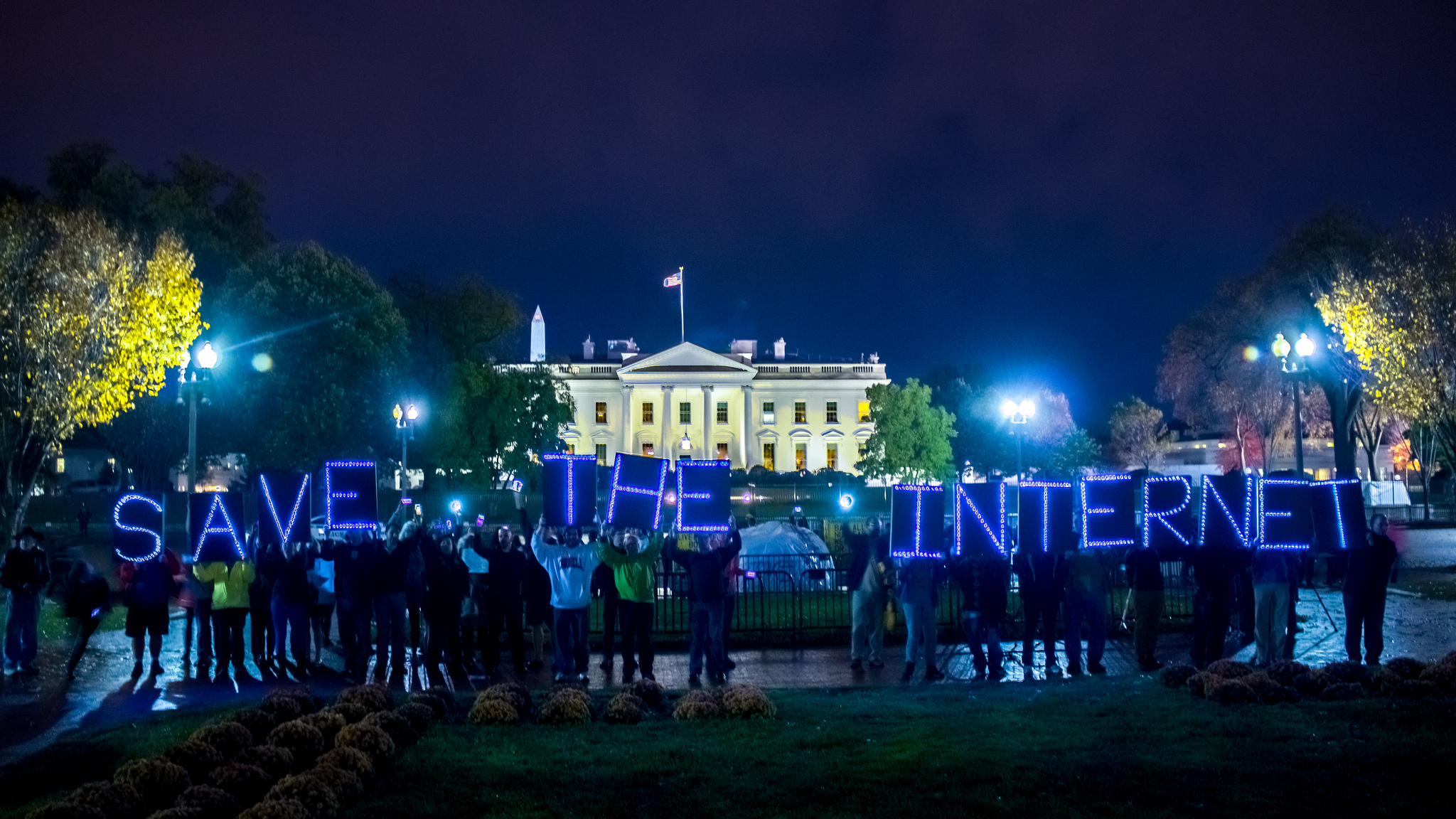
The concept of an “open internet”, or net neutrality, keeps internet service providers , or ISPs, from being able to alter how users are able to access web content. Specifically, it bans ISPs from being able to create internet “fast-lanes” or slow download speeds for web content that they wish to direct users away from. President Obama stated that he supports an “open internet” last year, three months before the Federal Communications Commission, or the FCC, was able to have rules enforcing net neutrality approved. Now, though, representatives from the telecommunications industry have come out in opposition of those rules, leading to the FCC to have to defend net neutrality in court this past Friday.

The FCC was originally able to get the “open internet” rules approved earlier this year by classifying ISPs as utility providers. This distinction gives the FCC more power to regulate ISPs. While the FCC believes that net neutrality supports businesses by keeping web services competitive, the telecommunications industry states that the new rules give the FCC too much control over the broadband market, hindering free enterprise instead of helping. Lawyers representing the views of the telecommunications industry argued that instead of being classified as utility providers, ISPs should be classified under information services, like Google. This classification would lessen the FCC’s ability so regulate ISPs and render the net neutrality rules inapplicable. The FCC argues, however, that without rules enforcing an “open internet”, ISPs will have too much power to promote certain web content over others. This could potentially hinder development and investment of new web content.

These arguments were presented to a panel of three judges who will release a decision in the spring which may approve or reject parts of the net neutrality rules.

Article via Buzzfeed, December 4, 2015

Photo: Protest at the White House for Net Neutrality via Joseph Gruber [Creative Commons Attribution-NonCommercial-NoDerivs]
Lawyers are a conservative group when it comes to adopting new technology. This continue to hold true for the ever popular cloud technologies. Concerns about privacy and security related to data breaches are holding some firms back from transitioning over to cloud storage and services. In a 2015 Cloud Security Survey released Netwrix reveals the concerns around cloud adoption among lawyers include: security and privacy of data (26 percent), migration costs (22 percent) and loss of physical controls (17 percent). Moreover, security risks include unauthorized access (32 percent), insider misuse (18 percent) and account hijacking (18 percent.)

Alex Vovk, CEO and co-founder of Netwrix, told Legaltech News “Legal departments will be reluctant to entrust their valuable data and customers’ sensitive information, until they are absolutely sure that cloud providers can offer better security than the company can ensure on-premises.” Although data security is a privacy issue for all industries, legal departments are less likely to adopt technologies that do not guarantee full protection for their data.

Law firms may be cautious, but that doesn’t mean that they are uninterested in cloud technologies. According to the survey, 44 percent of the respondents indicated they their firms were in a stage of evaluation and discovery concerning cloud services. “This indicates that [law firms] are potentially ready to invest more in additional cloud security and consider various cloud options,” Vovk said. In fact, when it comes to hybrid cloud models, legal entities have the same interest in making the transition as private companies. In addtion, 37 percent of those surveyed favor a private cloud model.

Vovk summed up by stating that “… as soon as cloud providers are ready to provide additional security measures and to some extent ease the compliance burden …lawyers would become less skeptic[al] about cloud adoption.”

Article via Legaltech News, 3 December 2015

Photo: Cloud Solutions via NEC Corporation of America [Creative Commons Attribution-NonCommercial-NoDerivs]

With companies and law firms around the world encountering problems with how to deal with cybersecurity, it’s no surprise that a report released by the international executive search firm Boyden indicates a growing need for technology officers. Not only that, but a statement released by Tim McNamara, co-founder of Boyden’s Risk Management and Security Sector, reveals that finding technology officers who are knowledgeable about all the intricacies of cybersecurity is difficult. McNamara states, “It’s a very complicated sector with bifurcated responsibilities. Consequently, there are multiple strategies to address cybersecurity needs among the commercial, military and defense, and intelligence segments.”

Basically, each company is going to face different risks when it comes to cybersecurity, and each company needs a unique strategy to prevent cyber attacks. Companies are especially in need of technology officers that can also hold leadership positions. It’s important for executives and other officials to be tech-savvy and understand the importance of cybersecurity, since the effects of a cyber attack are not limited to the IT department. Richard Fudickar, managing partner of Boyden Germany, explains that, “management must understand that this issue is about people and behaviors, not just technology.” This involves trusting chief information security officers and and chief security officers to influence executive decisions and be an active part of senior leadership teams. Ken Rich, a partner at Boyden New York, sums it up, saying, “Companies that have embraced the strategy of giving the CISO (Chief Information Security Officer) a seat at the executive table are better equipped to prepare for any breaches in cybersecurity.”

Finding technology officers with the leadership skills necessary to fill that seat may be hard to find, though. The Boyden report indicates that more than half of companies do not feel that they employ enough security officers. Companies may have to start hiring additional technology officers to fulfill the growing need to understand cybersecurity.

Article via Legaltech News, December 1, 2015

Photo: In the Digital Age via Ohad Ben-Yoseph [Creative Commons Attribution-NonCommercial-NoDerivs]