An International Conference on Online Dispute ResolutionODR2014 will bring together the technology and dispute resolution communities, legal practitioners, mediators and other ADR professionals, academic researchers, financial institutions, ecommerce companies and social media companies, members of judiciaries worldwide, and social justice advocates using innovative technologies to leverage change. ODR2014 is the thirteenth ODR Forum and the first to be held in the United States. The ODR Forum has previously been held in:

Geneva (2002 and 2003); Melbourne (2004); Cairo (2006); Liverpool (2007); Hong Kong (2007); Victoria (2008); Haifa (Israel) (2009); Buenos Aires (2010); Chennai (India) (2011); Prague (2012); Montreal (2013)

For more information, visit odr2014.org.

By Jeffrey M. Aresty

President, Founder, Internet Bar Organization

The changes resulting from the rise of the Internet are taking hold, and the legal community has yet to catch up to the way the world is now interacting. As our modes of business and daily interactions take place increasingly over the Web, the world is beginning to define the ways in which those exchanges will be characterized. This presents a new range of challenges for us in the legal field and as a global community, but it also presents an opportunity. Bringing the rule of law online will be an essential part of determining how we shape the future of global normative behavior and present an opportunity to redefine what we believe to be the right way to act, based not only on the multiplicity of laws as they stand, but rather based on a new organic democracy that will define itself in an harmonized way. The ability to negotiate, reach consensus, and resolve disputes online will be an essential set of skills for all who participate. But why does this new system of norms need to be defined in an haphazard fashion as countries everywhere come up with their own sets of laws to govern online behavior, leading to conflict and confusion?

Individuals from the online dispute resolution community have met regularly to examine the newest technologies and issues that are affecting justice in online interactions, and come this year to the United States to discuss topics like the role of privacy, identity and trust on the internet, and how they relate to justice.

This is where the role of trusted online communities comes into play. And one of the biggest factors in trust in online interactions is verification of and trust in identity. Just as a democracy depends upon the right of each citizen to their vote, access to justice for each individual in a globally based justice system depends upon being able to verify who is accessing the system, and making sure that the system is trustworthy in all respects, from the users to the design itself. Many individuals have spoken on the need to develop an “identity” layer of the internet that verifies user identity on top of the interactive web as a step toward solidifying trust in exchange and communication online. I believe this is the case, and that it will go hand in hand with the creation of what I call a “justice” layer — a new definition of normative behavior for how we relate to one another, including trust in identity. This will be supported not only by the legal complex, but also by global consensus and collective action toward what we define as justice. The resolution of disputes online will become a knowledge set that the legal community and others will need to understand.

But for every answer, there appear to be many more questions, particularly when dealing with the cultural technicolor fabric of our planet. For example, how do we balance the necessity of democracy through digital identification with, as the European Commission has defined, the right to be forgotten? How much control can and should we have over the information compiled online about our person? How much control should our government have?

Innovation has been helping to address some of these questions. Start-ups likeQredo and Wickr are taking steps to develop technology that will allow users access to secure platforms and close to complete control over their online identity and information. Checks and balances, peer review and transparency will also play a part in any viable system.

The creation of a technology-enabled system of effective democracy will require all segments of society to participate. Industry has the opportunity to play a leading role in helping shape a “justice layer” of internet communication on top of the internet communication protocol it helped to build over 20 years ago. It will also require the participation of academia, a non-fearing legal system, and the global community as a whole to create a truly “we the people” system of online governance.

Published originally by the Huffington Post.

Image courtesy of FreeDigitalPhotos.net/Stuart Miles.

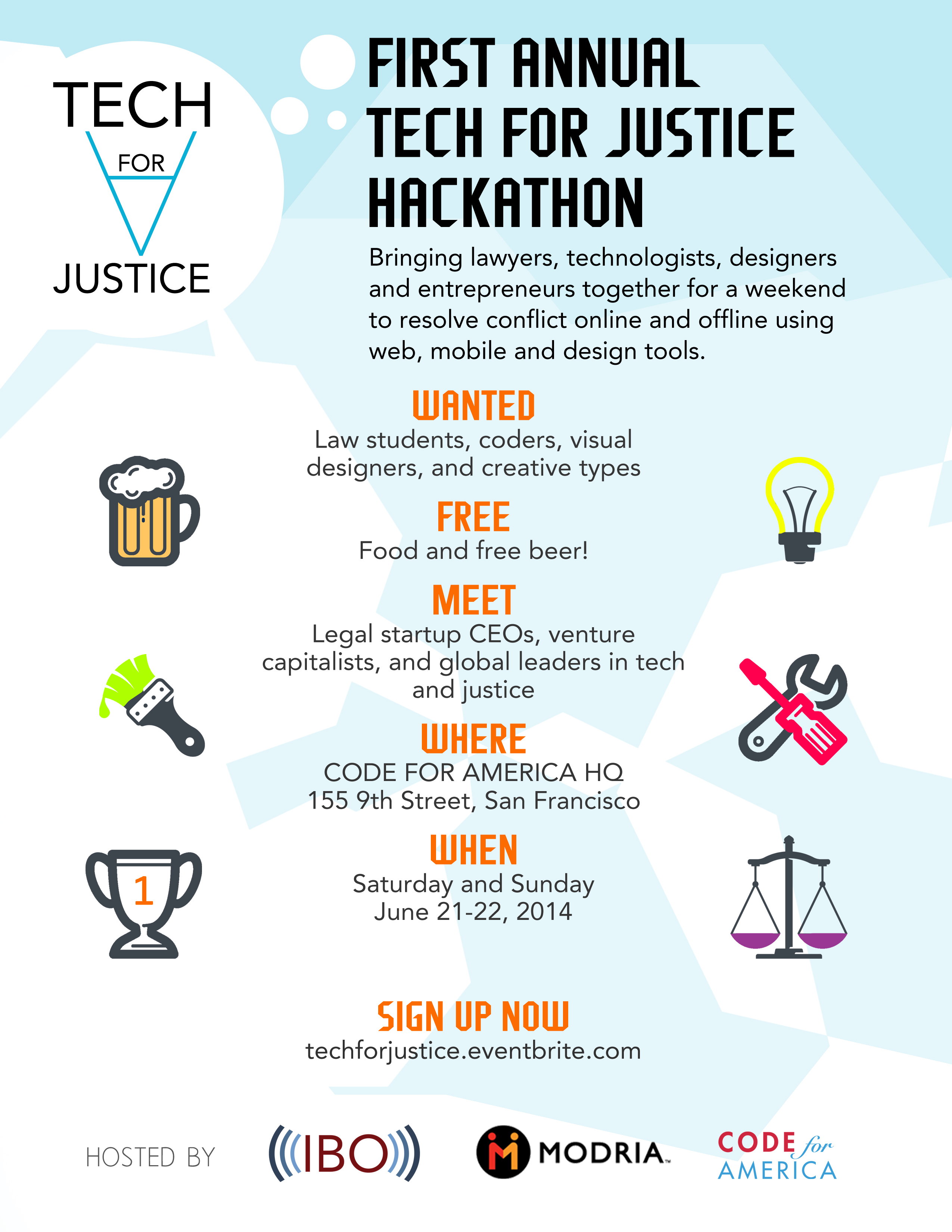
Hosted by IBO (parent of The Center), Modria, and Code for America, and in conjunction with the ODR2014 Conference,  the first ever dispute resolution hackathon was held the weekend of June 21-22nd tackling problems within 4 thematic areas, and producing prototypes that will be curated and presented to audiences at ODR2014’s UC Hastings event, where winners will be announced. The hackathon took place at Code For America‘s San Francisco Office.

The idea of a legal ‘hackathon,’ is a new one. To date, only a handful of legal hackathons have taken place in the United States, and none have specifically addressed dispute resolution.

The themes that were hacked include:

  • collaborative economy
  • cyberbullying & harassment
  • healthcare dispute management
  • environment
  • landlord & tenancy

Teams produced  5-15 minute presentations on the various themes and proposed a tech solution, how it addresses the issue, and its potential for scaleability.

Platforms included iOS; Mobile Web; Web; Mac Desktop; Windows Desktop
The Judges were:
Steve Baloff Advanced Technology Ventures (and Founder of Travelocity)
Tomio Geron Head of Content and Research, Exitround
Jason Mendelson Foundry Ventures
David Beyer Amplify Partners
Jeffrey Allen Graves & Allen
Ben Parr Co-Founder & Managing Partner of DominateFund; Former Co-Editor of Mashable
c6423ebb-f81d-4c6b-a554-39e7d967e6e7

Laying out the role of the computer forensics neutral expert (InsideCounsel, 27 May 2014) – When discovery in litigation involves the inspection of computer systems, setting out reasonable and effective protocols often involves a neutral expert in computer evidence. Working for the court, oftentimes at the direction of a special master, the neutral expert will engage with both parties, and often with computer forensics experts, to craft a reasonable inspection protocol. The challenge is to achieve consensus on the approach to preserving, performing analysis and review, and then producing relevant data. Protecting the producing party’s privacy/privilege while identifying only data that is responsive to the inspection demand must be balanced with the requesting party’s goal of finding all relevant evidence. Considering technology, discovery and forensic tools, and any agreements by the parties, the neutral expert must propose or assist with crafting an inspection protocol the parties to the litigation can agree to. Depending on the type of litigation, a company’s most sensitive data may be at issue and subject to discovery. Adequate review is hindered if full access to the relevant sources of data is not provided. Establishing the provenance of important documents, examining versions of source code, recovering evidence of the use of external media or the transfer of proprietary data can only be accomplished through the proper preservation and analysis of the right data sources. Conference calls to meet and confer to identify relevant sources and confirm preservation are crucial early in the inspection process. The neutral expert can work with the party’s IT administrators or consulting computer forensics expert(s) to map the sources of potentially relevant data. The potential evidence sought may inform what type of analysis is relevant. Some issues will involve common data sources, such as laptop and desktop user computers, email and shared network data. Other issues may require the examination of other sources of data, such as client relationship management (CRM) data or a source code revision control system. Whether the issue in the litigation involves allegations stemming from the use of a former employer’s client list or the alleged theft of IP, the neutral expert may need to take into account these additional data sources and prepare a reasonable review protocol. In cases involving the review and production of sensitive data, the consulting and neutral experts sometimes need to come up with a more elaborate protocol to address all the parties’ concerns. On a number of occasions, setting up a “clean room” with restricted access, no outside network connectivity and computer workstations for experts from both sides has been necessary. Protocols for the review and identification of relevant data are established. Procedures for turning over responsive data and the work product of subject matter experts are also spelled out. In these cases, the neutral expert will facilitate the work of other experts and the production of data among the parties.

Provided by MIRLN.

Image courtesy of FreeDigitalPhotos.net/twobee.

Disney decides to ‘Let It Go’ when it comes to copyright infringement (InsideCounsel, 23 May 2014) – If you have kids – or a pair of ears, I suppose – you have likely heard the infectious song “Let It Go” from the mega-hit movie “Frozen.” The animated movie, based on the Hans Christian Andersen tale “The Snow Queen,” has won Academy Awards, raked in hundreds of billions of dollars worldwide, and sent toes-a-tappin’ with an Oscar-winning song. These days, though, whenever something in popular culture is well known, it becomes fuel for the content creation fire. People from all over the world have taken copyrighted content from “Frozen,” like the hit song, and posted images and videos that infringe on Disney’s intellectual property. On YouTube, one can find versions of “Let It Go” that are sing-alongs, mashups, covers and parodies. Some of these videos have racked up millions of pageviews. So, why isn’t the Mouse House apoplectic over the clear infringement of its intellectual property ? There was a time when Disney’s leadership viewed YouTube as an opportunity for fans to engage in mass piracy. Disney’s own efforts to establish an online presence have been lukewarm until recently. In March of this year, it purchased Maker Studios, a company that produces YouTube videos, tapping into amateur creators to provide content. This acceptance of the popularity of fan-created content as a way to expand the brand and engage fans does not mean that Disney’s position on copyright infringement has softened completely. The company has fought to extend the copyright of its most iconic creation, Mickey Mouse, lobbying Congress to extend the copyright protection period another 20 years.

Provided by MIRLN.

Image courtesy of FreeDigitalPhotos.net/Stuart Miles.

US companies hacked by Chinese didn’t tell investors (Bloomberg, 21 May 2014) – Three U.S. public companies identified as Chinese hacking victims didn’t report the theft of trade secrets and other data to investors, despite rules designed to disclose significant events. Two of the companies—aluminum maker Alcoa Inc. (AA) and metals supplier Allegheny Technologies Inc. (ATI)—said the thefts weren’t “material” to their businesses and therefore don’t have to be disclosed under Securities and Exchange Commission rules designed to give investors information that may affect share prices. “The question is would an investor have cared if Chinese hackers broke into a company and were messing around the place?” Jacob Olcott, a principal focusing on cybersecurity at Good Harbor Security Risk Management LLC in Washington, said in a phone interview. “As an investor, show me the evidence that you reviewed this thoroughly.” Scott Kimpel, a lawyer who previously worked on disclosure rules as a member of the SEC’s executive staff, said there is “a gray area where a lot of the companies are not perfectly clear on what they should be disclosing.” [ Polley : In early 2011 at least one oilfield company also decided that a cyberattack wasn’t “material” – see Exxon, Shell, BP Said to Have Been Hacked Through Chinese Internet Servers in Mirln 14.03 ]

Provided by MIRLN.

Image courtesy of FreeDigitalPhotos.net/xedos4.