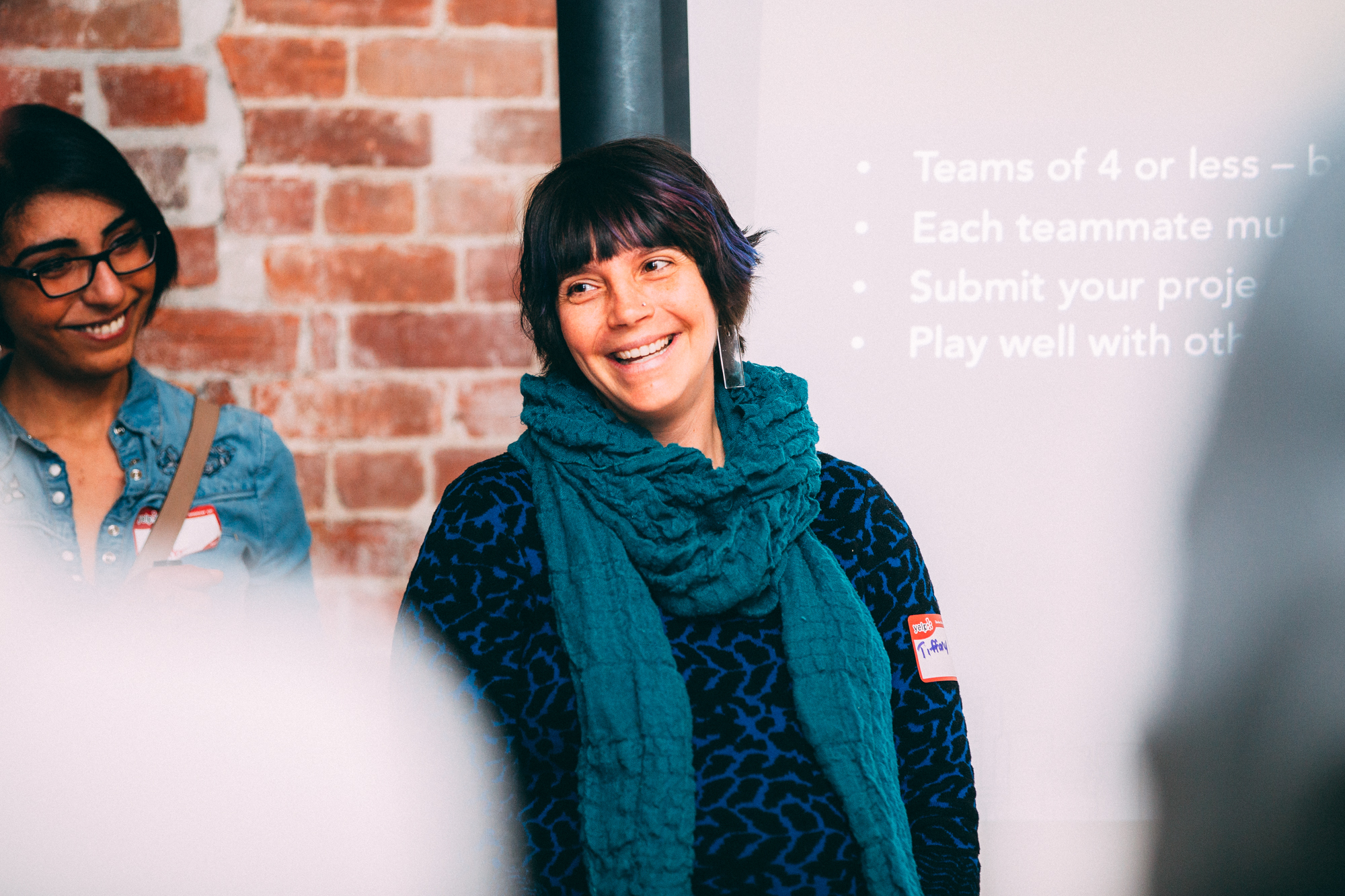
Tami Reiss aims to prevent the use of tentative, apologetic qualifiers that many women use in the workplace with her new Gmail plug-in, Just Not Sorry. Offered for Google Chrome, the plug-in underlines tempering words like “sorry” and “just” written in emails and alerts the user with a pop-up describing the used phrase’s connotation. Tami Reiss is the CEO of the consulting firm Cyrus Innovation.

“The women in these rooms were all softening their speech in situations that called for directness and leadership,” Reiss said of her experience working at Cyrus Innovation. “We had all inadvertently fallen prey to a cultural communication pattern that undermined our ideas. As entrepreneurial women, we run businesses and lead teams—why aren’t we writing with the confidence of their positions?”

The plug-in has inspired a movement to ensure that #10000women send direct, unapologetic emails consistently throughout 2016. It has already been downloaded by thousands of users.

“This app prevented me from needlessly writing I am sorry in 6 emails today alone,” wrote one user in a review on Google Chrome’s Web Store. “LOVE IT. Thank you. #sorrynotsorry.”

Article via Good, 30 December 2015

Photo: Yackathon! Yelp’s First Community Hackathon in Montreal by Yelp Inc. [Creative Commons Attribution-NonCommercial-NoDerivs]

Facebook is promising to fight hate speech amid the European refugee crisis.

“In the past year, we’ve seen millions of people come together online to support refugees and stand in solidarity with the victims of terror attacks,” wrote Facebook COO Sheryl Sandberg in a post on Monday. “But we’ve also heard voices of hate growing louder. With extremism damaging lives and societies across the world, challenging those voices has never been more important.”

The company did not disclose a particular plan, but they did announce the Online Civil Courage Initiative, meant to empower users to fight against hate speech. It also appears that Facebook will be backing more powerful non-governmental organizations which are already involved in fighting radicalism and hate speech online.

The Online Civil Courage initiative is yet another effort to prevent hate speech on social media. In December, Facebook and other companies like Google and Twitter agreed to remove instances of hate speech within 24 hours, in accordance with an agreement with Germany authorities. German politicians and celebrities also voiced concern about rising hatred on social media, as nearly 1.1 million migrants and refugees entered the country in 2015 alone. Last August, Germany’s minister of justice asked Facebook to remove racist posts targeting asylum seekers.  Three months after that prosecutors opened a criminal investigation because they suspected that Facebook failed to take down a wave of anti-immigrant posts on the social network, inciting racial hatred.

Following the terror attacks in Paris, France also called on Facebook, Twitter, Apple, Google and Microsoft to combat extremist propaganda and expand safety tools in the event of a future attack.

“Hate speech has no place online — or in society,” Sandberg said. “Together, we can make sure the voices of peace, truth and tolerance are heard. Love is louder than hate.”


Article via Mashable, 19 January 2016

Photo:Facebook icon by Jurgen Appelo[Creative Commons Attribution-NonCommercial-NoDerivs]

Handshake Software, a provider of SharePoint-based products and services to the legal market, announced its tech integration Ravel Law, a legal search, analytics, and visualization platform. The move is based on the need to provide a legal search product to law firms that will allow them to be more efficient in their practice.

Glenn LaForce, vice president of global sales & marketing at Handshake Software stated, ““Attorneys are under tremendous pressure from their clients with regards to the billable hour, so bringing together as many data sources as possible into one universal search is paramount for their practice,” he said. “To be able to perform legal research while seeing key financials, internal documents, contacts and internal expertise helps the attorneys become more efficient and effective.

This move is a strategic integration between the two companies products. By combining these technologies, the users Sharepoint experience will include search that allows for all knowledge to be in one place. LaForce confirms this by saying, “Lawyers, CIOs and knowledge management professionals tell us they want one system to deliver one-stop [knowledge management] information to their users. Our integration with Ravel Law is another important aspect of the Handshake Software’s all-encompassing solution that includes integration to online legal research and other major legal applications.”

The goal is to provide and environment where users will have access to critical firm data as well as online law research materials. This allows attorneys to more effectively manage the business and practice of law. We’re excited to bring these technologies to lawyers in one easy-to-find location,” said Nik Reed, co-founder and chief operating officer at Ravel Law.


Article via LegalTechNews, 12 January 2016

Photo:Assignments by Ryan Hyde [Creative Commons Attribution-NonCommercial-NoDerivs]

A new Federal Communications Commission report states that around 10 percent of Americans have no access to broadband, translating to around 34 million people without the ability to use high-speed Internet. The FCC defines “broadband” as Internet service that facilitates download speeds of 25 Mbps and upload speeds of 3 Mbps.

This year’s definition is controversial because of its new, higher standards. Last year the FCC classified broadband as Internet that enabled 10 Mbps for downloads and 1 Mbps for uploads. Critics argue that the FCC will create stricter requirements for Internet providers, who have already released statements saying that the new report on American access to high-speed Internet “lacks credibility.”

The United States Telecom Association, a trade group that represents telecommunications-based organizations in the U.S., states that the FCC is using the report as an excuse to extend its influence on Internet providers. “This annual process has become a cynical exercise, one that… is patently intended to reach a predetermined conclusion that will justify a continuing expansion of the agency’s own regulatory reach,” said US Telecom on Friday.

However, the FCC’s role is not limited to the chastisement of big-business Internet providers. The government will be taking several actions to increase access to high-speed Internet throughout the country, including the reformation of a low-income telephone subsidy program and the allocation of millions of federal dollars to Internet providers’ construction projects.

“Advanced telecommunications capability is not being deployed in a reasonable and timely fashion to all Americans,” stated an FCC factsheet.

Article via The Washington Post, 8 January 2016

Photo via country road by Remko Tanis

Google has been famously testing out their version of a driverless car. The company wants to transform transportation by taking the driver out of the equation.

Driverless cars will be able to shuttle people from place to place while reducing the human error that is often the catalyst for road accidents.The California Department of Motor Vehicles recently made a proposal of rules for driverless cars. These new rules were presented for public commentary in mid December of 2015. The DMV wants to involve the public and will be hosting two workshops early in 2016, one in Sacramento and the other in Los Angeles.This proposal draft is the next step in allowing driverless cars on California roads. But Google is unhappy about one of the provisions.

The regulators are calling for the manufacturers of driverless cars to meet several safety and performance standards. These include things such as protecting the privacy of operators from the needless collection of user data and having a third party independently access performance. The rules also call for a licensed human driver, capable of taking over the steering wheel and pedals in the event of an emergency. The problem is that Google’s prototype for a driverless car does not have a steering wheel or pedals.

Google’s maintains that it wants to improve safety by equipping the car itself with protocols that surpass what a human could detect. For instance their cars have sensors that detect objects as far as two football fields away–in all directions. The state of California is looking at the broader aspect of autonomous cars, and remains more conservative on the issue. They  have warned Google in the past to add steering wheels and pedals. California legislators pushed The DMV to require that driverless cars contain wheels and people to steer them whenever they’re operated on public roads.

Google is disappointed that California legislators are limiting the potential of fully autonomous vehicles, the company said. Although the company is still in the prototyping phase where changes can easily be made, it is still a setback.


Article via TechNewsWorld, 18th December 2015

Photo:Auto che guidano da sole. Forse non le vedremo mai sulle nostre strade by Automobile Italia [Creative Commons Attribution-NonCommercial-NoDerivs]

Facebook’s initiative to provide Internet to developing parts of the world, Free Basics, has been met with substantial criticism from those who believe that the service violates Net Neutrality. This Monday, Facebook CEO Mark Zuckerberg defended the service in an opinion article in the Times of India.

Zuckerberg’s effort to offer free Internet throughout India was obstructed by the country’s Telecom Regulatory Authority’s request that Facebook discontinue the program. India has 132 million active Facebook users, the second largest population of Facebook users behind the Unite States’ 193 million users.

Critics argue that Free Basics, the website that offers Internet services, provides more content from Facebook than from other sources. When Zuckerberg visited India in October, however, he implied that the Facebook service did not breach Net Neutrality when he said that all traffic on the Internet should be treated equally.

“Instead of wanting to give people access to some basic Internet services for free, critics of the program continue to spread false claims—even if that means leaving behind a billion people,” Zuckerberg said. “Who could possibly be against this? Choose facts over false claims. Everyone deserves access to the Internet.”

Article via CNET, December 28, 2015

Photo: Mark Zuckerberg via Mathieu Thouvenin [Creative Commons Attribution-NonCommercial-NoDerivs]