Virtually all industries are being affected by the complexities of cybersecurity and privacy law. In addition to being somewhat confusing, aspects of cybersecurity and privacy law can change practically overnight. With this in mind, the international law firm Akerman now offers a constantly updating web-based legal knowledge platform on cybersecurity and privacy law named the Akerman Data Law Center. Developed in conjunction with Thomson Reuters and Neota Logic, the platform makes the international rules and regulations regarding cybersecurity more accessible. This tool will be useful for law firms everywhere, since cybersecurity and privacy are “likely to have accelerated growth in the law market for 2016,” as explained by Akerman’s Data Law Practice co-chair, Martin Tully. In addition to always being up-to-date, the platform can be used to research changes that only pertain to specific regions or industries. This could be extremely useful to law firms that operate in several jurisdictions and want to be able to keep track of the differences in regulations between regions.

Though access to the research compiled in the Akerman Data Law Center will require a subscription fee, Akerman states that the platform will save users up to 80% on research costs. When compared to the number of hours associates could spend accumulating the research already available within the platform, the Akerman Data Law Center is more efficient and less expensive. To make the platform even more user friendly, Akerman even allows users to contact them directly for particularly challenging questions, which will prove useful for firms that do not have the funds to consult with experts constantly.

Article via Legaltech NewsNovember 20, 2015

Photo: Chained and locked via Vivek [Creative Commons Attribution-NonCommercial-NoDerivs]


Many of the 770,000 refugees who have migrated to Europe since January are from middle-class backgrounds, and are therefore educated and tech-savvy. As a result, most use smartphones for GPS navigation and communicate with family through Facebook, Viber, WhatsApp, and Line apps.

With the understanding that smartphones are invaluable tools to refugees, tech companies and aid groups have directed their efforts to creating tech-focused ways to help refugees communicate and travel safely. For example, Google, the International Rescue Committee (IRC) and Mercy Corps collectively launched refugeeinfo.eu last month. The website explains the registration process, locations to eat and sleep, medical help, and traveling to Athens for those who land on the beaches of Greece.

Rey Rodrigues, IRC’s technology coordinator, describes the intentions of refugeeinfo.eu: “We wanted to create a roadmap. You see a lot of refugees walking with their smartphones and power cords and extra batteries. This lets them be self-sufficient.”

It is not uncommon for a refugee to walk up to 10 hours to register with Greek authorities at the southern part of the island, when buses are available for free. The roadmap’s goal is to provide valuable information like this to refugees, especially when translators are not available to convey the information.

Refugeeinfo.eu is one of many tech resources available to refugees. Disaster Tech Lab recently supplied Wi-Fi access to two refugee camps in Lesbos. InfoAid, an android app built by a Hungarian couple, helps refugees access train tickets, medical care and water. First-contact.org provides contact to local NGOs and offers specific information on how to survive on the Greek islands of Lesbos and Samos.

Article via Mashable, November 8, 2015

Photo: Liqaa with her daughter Limar born on August 3, 2013 via Oxfam International [Creative Commons Attribution-NonCommercial-NoDerivs]

Five years ago, companies like Ancestry.com and 23andMe provided the option of genealogy tracing and medical diagnostic tests for customers who submitted DNA samples. At the time, privacy advocates warned of the potential risks of letting businesses collect genetic databases.

Privacy advocate Jeremy Gruber summed it up in 2010 when he said that genetic material “has serious information about you and your family.” This information, if used beyond the purposes of genealogy tracing, has big implications in law enforcement and government tracking. Wired magazine cautioned, “Your relative’s DNA could turn you into a suspect.”

Currently, the FBI keeps a national genetic database of the DNA of convicts and arrestees. Both companies’ privacy policies state that upon court order, DNA information will be given to law enforcement. Yet, as Wired implicated, people have been wrongly accused of crimes for DNA near-matches in the past.

23andMe recently launched a transparency report, similar to other major tech companies that receive government requests for consumer information, within the next month.

“In the event we are required by law to make a disclosure, we will notify the affected customer through the contact information provided to us, unless doing so would violate the law or a court order,” said the company’s first privacy officer Kate Black.

Ancestry.com will not state explicitly how many government data requests the company has recieved.

“On occasion when required by law to do so… we have cooperated with law enforcement and the courts to provide only the specific information requested,” said a spokesperson.

Article via Fusion, October 16, 2015

Photo: DNA isolation 5 via Patrick Alexander [Creative Commons Attribution-NonCommercial-NoDerivs]

This past Thursday, the Social Security Administration announced that citizens would be able to apply for replacement Social Security card documents online. Although the program only applies to basic card replacements, it will expedite the process for many Americans who had to physically wait in line at a government building in order to fill out the paperwork for renewal. The program will first be introduced to Wisconsin and Washington state before extending to the rest of the nation.

Nancy Berryhill, the deputy commissioner for operations at the Social Security Administration, said, “It’s not only convenient for the public, but also for our field employees. It’s something we’ve been thinking about for a long time.”

The development of the program was lengthy due to the issues of authenticating and securing individuals’ identities. Those who apply for replacement cards online will have to sign up for a “my Social Security” account and answer personal questions from their credit history, provided by the Equifax credit-card rating bureau. The account will also ask for a driver’s license or state ID card numbers, to be compared to the records of individual states. Lastly, a fraud protection review will scan the submitted information for a authenticity.

Rob Klopp, the deputy commissioner of systems and the agency’s chief information officer, said that the agency is still researching methods to recognize fraud. “We’re going to learn how others try to game us,” he said.

Article via The Washington Post, November 19, 2015

Photo: The Bank of Queue via tubb [Creative Commons Attribution-NonCommercial-NoDerivs]

If you haven’t heard of TED yet, it’s a nonprofit organization devoted to Ideas Worth Spreading. The main conference is held in California and was started 25 years ago, and it’s influence has been growing exponentially since then. All other TED events are called TEDx and are independently organized TED-like events with the same mission. These events often discuss science, technology, education and communication and have been known to spark innovation and social change by  providing the opportunity to shed light on less known facts and causes that are happening at a  local level.

I had the pleasure of attending the TEDxHouston 2015 event this year, where there were several talks  highlighting themes of social change, innovation and technology.

Teresa O’Donnell, Founder of  Plant It Forward  , spoke of her professional life as an entrepreneur. In an effort to do more community work through her company, she studied and became more informed on the plight of refugees coming to America.  For those who seek refuge in this country, it takes a minimum of 5 years to achieve that status. A refugee must prove that conditions in their  home country are incredibly difficult (persecution and war)and that it  has become impossible for them to return home without fearing for their lives. Houston, Texas in particular has received a large number of these refugees. Once the refugees arrive in the United States, they face the confounding problem of not speaking the dominant language, as well as not having transferable work skills.

To solve this problem, Plant It Forward partners with social and church groups to provide land and tools to refugees who settle in Houston with few other skills besides farming. Houston now has a growing community of organic gardens that sell  fresh fruit farmed by refugees at local farmers markets. Through Plant It Forward farms, refugees have the opportunity to build a life for themselves and their family while enriching the city with their farming skills.

Enriching the city was a theme that arose continually throughout the day. Susan Rogers focused on  community development and city planning; she works as a designer, professor and director of the Community Design Resource Center (CDRC) in Houston. The CDRC’s  goal is to use design to enhance change in the community and are focused on serving the public interest by improving the development of all communities. She spoke specifically about the economic disparities existing between the eastern and western half of the city, and how this is reflected in the design and therefore service of the communities. By preserving the culture and uniqueness of all neighborhoods, it improves other public services that cater to their residents, thereby raising the standard of life for all.

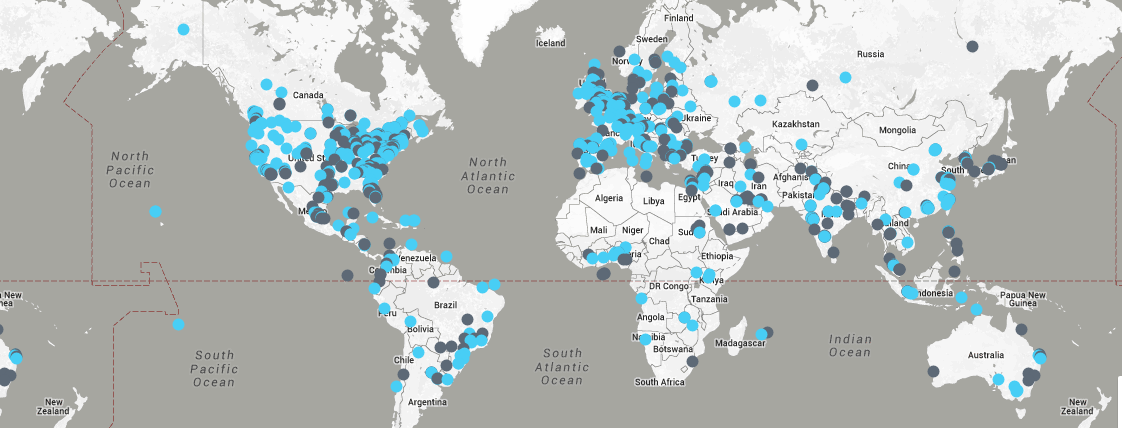
Talks like these are not just  happening in the United States, they happen all over the world. In 2015 there are over 3000 Ted events scheduled with talks about everything from education, to medicine, to life and career.

TED around the world

If you don’t have time to attend a TED event, you can easily watch a recording which is  available for free at TED.com. Talks are even arranged by topic and influence in convenient playlists.

The true power of TED comes from the opportunity to see the world through someone else’s eyes, and become aware of possibilities that you may not have known existed. TED provides a platform to bring to light issues that are too often not discussed and gives insight into the wonder of the human spirit,  reminding us how truly amazing it is to reimagine the world the way that we believe it should be.

Photo via: Ted.com

Though it may seem surprising, most legal rulings, despite being public domain, are not available for free to the general public. Harvard owns the most comprehensive collection of U.S. case files, a collection second only to that of the Library of Congress. The Harvard Law School Dean Martha Minow believes that “law should be free and open to all,” though. In order to make that belief a reality, Harvard has partnered with legaltech startup Ravel Law to digitize its legal library. It will take a team of seven people to carefully take apart more than 40,000 physical books of case files and scan them. After all of the case files have been digitized, Ravel Law will make the database of legal research searchable and available online for free. Additionally, the creators of Ravel Tech hope to add the ability to visually represent connections between cases in order to better visualize patterns over time.

Though anyone will be able to access these digitized case files for free, this “Free the Law” project will also help small firms that are not able to afford access to large legal research databases like LexisNexis and WestLaw. Additionally, the creators of Ravel Tech hope that other innovators and nonprofits will be interested in developing their own search and analysis tools for the case files. These tools, search functions, and visual maps that Ravel Law hopes to implement will be especially important. Jonathan Zittrain, a Harvard law professor and director of the law library, explains that, “It’s one thing just to access it in a book. It’s another to be able to build relationships among cases because nobody reads the law from cover to cover starting with the first book.”

Article via BuzzfeedNovember 9, 2015

Photo: This Book via Bob AuBuchon [Creative Commons Attribution-NonCommercial-NoDerivs]